Saltwater fishing can mean casting from a beach, dropping bait from a pier, working shallow flats from a skiff, or trolling offshore for fast-moving pelagic fish.
The right approach depends on where you fish, what species you want to catch, how deep the water is, what structure is nearby, and what gear you have available.
This guide explains the main types of saltwater fishing, the gear used for each method, common techniques, target species, bait choices, tackle basics, safety considerations, and beginner-friendly ways to get started.
Whether you are planning your first pier trip or trying to understand the difference between inshore, nearshore, offshore, reef, and deep sea fishing, this guide gives you the foundation before you choose a setup or book a trip.
Key Takeaways
- Saltwater fishing includes shore-based, inshore, nearshore, offshore, reef, wreck, flats, backcountry, kayak, charter, and party boat fishing.
- The best setup depends on the location first, then the target species, water depth, current, structure, and bait presentation.
- Surf fishing, pier fishing, and inshore fishing are usually the easiest entry points for beginners because they do not require specialized offshore gear.
- Trolling, bottom fishing, jigging, chumming, drift fishing, and fly fishing are common saltwater techniques, but each works best in specific conditions.
- Braided line, fluorocarbon leader, circle hooks, spinning reels, conventional reels, landing nets, gaffs, fish finders, and marine GPS all have specific roles in saltwater fishing.
- Common saltwater species include speckled trout, redfish, snook, striped bass, tarpon, bonefish, permit, snapper, grouper, flounder, cobia, king mackerel, tuna, mahi-mahi, sailfish, marlin, and sharks.
- Beginners should start with a practical spinning setup, learn how tides and structure affect fish movement, and check local regulations before every trip.
What Is Saltwater Fishing?
Saltwater fishing is fishing in marine or brackish water.
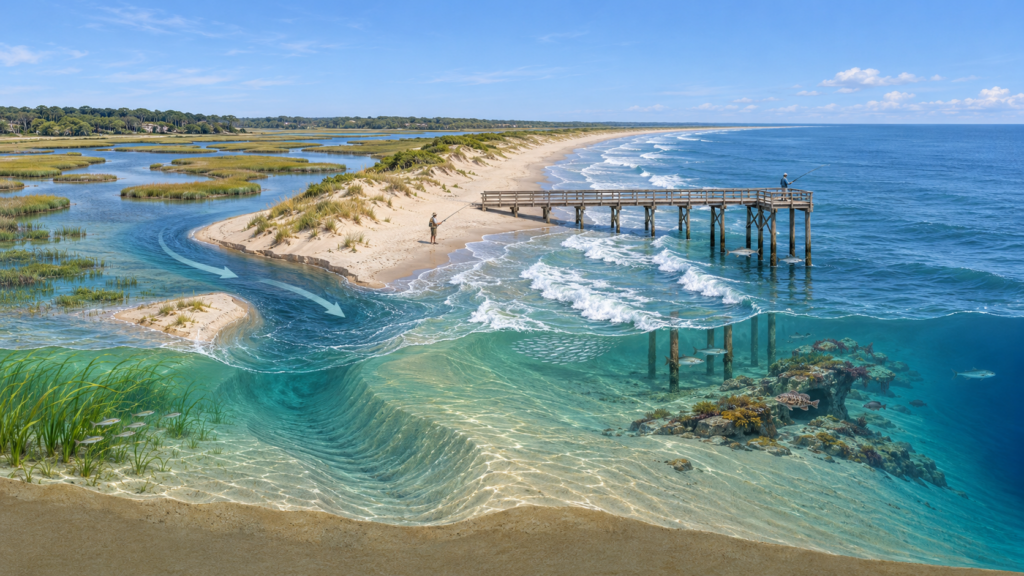
That includes oceans, bays, estuaries, beaches, piers, jetties, tidal rivers, flats, reefs, wrecks, passes, channels, and coastal marshes.
The term covers many styles of fishing.
A beginner casting bait from a pier is saltwater fishing, and so is an offshore crew trolling for tuna, mahi-mahi, marlin, or sailfish.
The main difference is the environment.
Saltwater fishing involves tides, current, waves, wind, salt exposure, bait movement, and stronger gear demands.
Fish often move with the tide.
Incoming water can push bait onto flats and shorelines, while outgoing water can pull bait through channels, creek mouths, passes, and cuts.
Saltwater also wears down gear faster.
Reels, hooks, swivels, pliers, rods, and landing tools need to handle salt, sand, moisture, and stronger fish.
Saltwater Fishing vs Freshwater Fishing
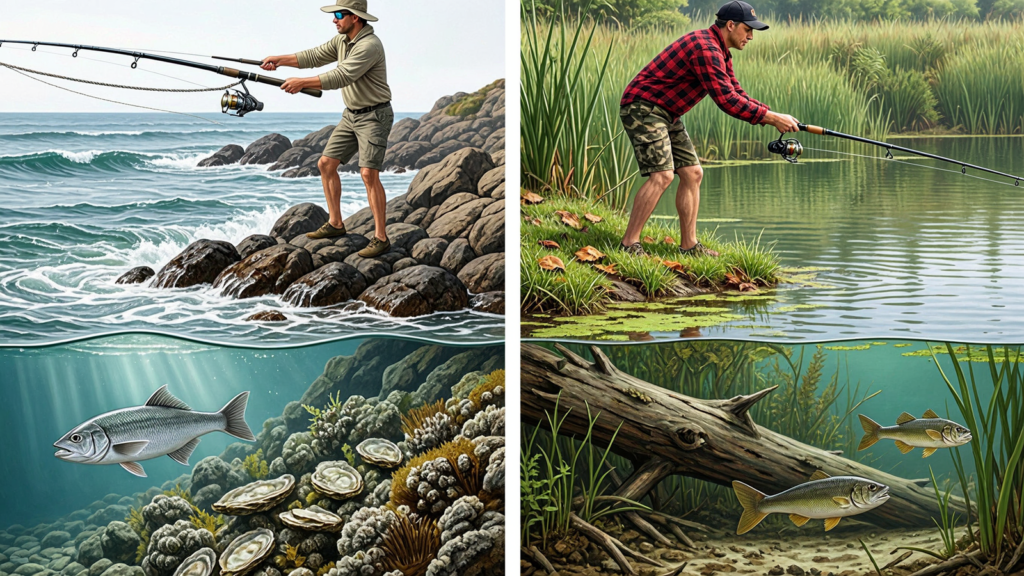
Saltwater and freshwater fishing share many skills, but the conditions are different.
Casting, knot tying, drag control, fish handling, and reading structure all carry over.
The bigger adjustment is learning how tides, current, bait movement, wind, and saltwater structure affect fish behavior.
| Factor | Saltwater Fishing | Freshwater Fishing |
| Common water bodies | Ocean, bays, estuaries, flats, beaches, reefs, wrecks | Lakes, ponds, rivers, streams, reservoirs |
| Main conditions | Tides, current, wind, waves, salinity, bait movement | Water level, flow, clarity, vegetation, temperature |
| Gear needs | Corrosion-resistant reels, stronger leaders, heavier hooks | Often lighter gear, depending on species |
| Common access points | Beach, pier, jetty, skiff, kayak, charter, offshore boat | Bank, dock, kayak, canoe, bass boat, wading area |
| Common species | Redfish, snook, trout, tarpon, snapper, grouper, tuna, mahi-mahi | Bass, trout, catfish, panfish, pike, walleye |
| Key planning factor | Tide, weather, structure, bait movement | Season, cover, water temperature, depth, flow |
Why Saltwater Fishing Requires Different Gear
Saltwater gear needs to resist corrosion and handle stronger pressure.
A saltwater-rated reel should have a smooth drag, enough line capacity, and parts built for repeated salt exposure.
Braided line is common because it is strong, sensitive, and thin.
Fluorocarbon leader is often added near the hook because it resists abrasion and is less visible underwater.
Circle hooks are common for bait fishing because they often hook fish near the corner of the mouth.
Pyramid sinkers help hold bait in the surf, bottom rigs keep bait near reefs and wrecks, and popping corks suspend bait over grass flats and shallow bays.
Saltwater gear does not need to be expensive.
It needs to match the location, target species, structure, and conditions.
How to Choose the Right Type of Saltwater Fishing
Saltwater fishing is easiest to choose by access, not by species alone. Start with where you can safely fish, then match the method, gear, bait, and target species to that location.
Some options are simple and low-cost, like pier fishing or surf fishing. Others require a boat, better weather planning, heavier tackle, and a larger budget, such as nearshore, offshore, reef, and wreck fishing.
| Type of Saltwater Fishing | Choose This When | Best For | Main Trade-Off |
| Surf fishing | You have beach access and want a low-cost shore setup | Beginners, beach anglers, bait fishing | Casting distance and surf conditions matter |
| Pier fishing | You want deeper water without a boat | Beginners, travelers, mixed species | Crowds, pier rules, and landing fish from height |
| Jetty fishing | You want current, rocks, and structure from shore | Intermediate shore anglers | Slippery footing and break-offs |
| Inshore fishing | You want variety without running far offshore | Trout, redfish, snook, flounder, tarpon | Tide and local structure matter |
| Nearshore fishing | You want reefs, bait schools, and coastal predators close to land | Snapper, cobia, mackerel, sharks | Weather risk increases outside protected water |
| Offshore fishing | You want larger fish and deeper-water species | Tuna, mahi-mahi, marlin, sailfish, wahoo | Higher cost, heavier gear, longer trips |
| Reef fishing | You want bottom fish around hard structure | Snapper, grouper, amberjack | Fish can break off quickly |
| Wreck fishing | You want structure fishing with larger targets | Grouper, snapper, cobia, amberjack | Requires GPS, sonar, and strong leader |
| Flats fishing | You want shallow-water sight fishing | Bonefish, permit, redfish, tarpon | Stealth and casting accuracy matter |
| Backcountry fishing | You want quiet creeks, mangroves, and marsh drains | Snook, redfish, trout, tarpon | Easy to spook fish in shallow water |
| Kayak fishing | You want affordable small-craft access | Protected bays, flats, creeks | Wind, tide, and boat traffic matter |
| Charter fishing | You want guidance, gear, and local knowledge | Beginners, travelers, specialized trips | Higher cost than fishing on your own |
| Party boat fishing | You want boat access at a lower cost | Reef, wreck, and bottom fishing | Less personal instruction and flexibility |
When Shore-Based Saltwater Fishing Is the Best Choice
Shore-based fishing is the best choice when you want a simple, affordable way to start. It works well for beginners because you can learn casting, bait presentation, knots, tides, and fish handling without buying a boat or booking a full charter.
The main limitation is range. Since you are fishing from a fixed position, success depends on choosing places where fish naturally come within casting distance, such as surf troughs, pier pilings, jetty rocks, bridge shadow lines, inlet current seams, and deeper cuts near shore.
Choose surf fishing if you have beach access and want a simple bait or lure setup. It works best when you can read troughs, sandbar edges, cuts, current seams, and visible bait close to shore.
Choose pier fishing if you want the easiest access to deeper water. It is often the most beginner-friendly shore option because the structure attracts baitfish, and the pier gives you reach without needing a long surf cast.
Choose jetty fishing if you want stronger structure fishing from shore. It can produce bigger fish, but it also requires better footing, heavier leader, and more control because rocks and barnacles can cut line quickly.
| Shore Option | Best Fit | Skill Level | Gear Priority |
| Surf fishing | Beach access and simple bait fishing | Beginner to intermediate | Surf rod, pyramid sinker, sand spike |
| Pier fishing | Easy access to deeper water | Beginner | Spinning reel, bait bucket, pier net |
| Jetty fishing | Current and rocky structure | Intermediate | Cleats, heavier leader, landing net |
| Bridge fishing | Current seams and shadow lines | Beginner to intermediate | Strong leader, bait or jigs |
| Seawall fishing | Urban or easy-access structure | Beginner | Spinning setup, live bait, lures |
When Inshore Fishing Is the Best All-Around Choice
Inshore fishing is often the best all-around choice for anglers who want variety without the cost and risk of offshore fishing. Bays, estuaries, grass flats, marshes, tidal creeks, docks, mangroves, oyster bars, passes, and channel edges can all hold fish.
Choose inshore fishing when you want to target species like speckled trout, redfish, snook, flounder, striped bass, tarpon, bonefish, or permit. It usually works best with light to medium spinning tackle, braided line, fluorocarbon leader, live bait, soft plastics, spoons, jerkbaits, or popping corks.
The main reason to care about inshore fishing is repeatability. It is easier to fish often, learn local tides, test different lures, and build skill without needing a large boat or expensive offshore setup.
Flats fishing is best when you want visual, shallow-water fishing. It rewards stealth, accurate casting, polarized sunglasses, and quiet boat control more than heavy gear.
Backcountry fishing is best when you want protected water, mangroves, creeks, marsh drains, and shallow channels. It is productive when fish are using quiet areas for feeding or shelter, but it can be easy to spook fish in calm, clear water.
| Inshore Choice | Choose This When | Avoid This When |
| General inshore fishing | You want variety with lighter tackle | You only want deep-water or offshore species |
| Flats fishing | You can sight fish in shallow water | Wind, dirty water, or poor visibility make spotting fish hard |
| Backcountry fishing | You want quiet protected water | You cannot navigate shallow creeks or changing tides |
| Dock and bridge fishing | You want structure close to access points | You are using leader too light for pilings and barnacles |
| Passes and channels | You want current-driven feeding areas | Current is too strong for your rig or boat control |
When Nearshore Fishing Makes Sense
Nearshore fishing makes sense when you want to move beyond protected bays but do not want the cost, distance, or exposure of a full offshore trip. It is a good middle step for anglers who already understand basic tackle, weather checks, and boat safety.
Nearshore anglers often fish reefs, rock piles, artificial structures, coastal wrecks, bait schools, ledges, and current edges. Common targets include snapper, cobia, king mackerel, Spanish mackerel, sharks, and other coastal predators.
Choose nearshore fishing over inshore fishing when you want bigger fish, more structure, and more open-water opportunities. Choose inshore instead when wind, waves, storms, or boat size make leaving protected water unsafe.
The risk vs reward is simple. Nearshore fishing can produce stronger fish and better variety, but conditions can change faster outside protected water.
| Decision Factor | Nearshore Fishing |
| Best for | Reefs, bait schools, coastal wrecks, mackerel, snapper, cobia |
| Skill level | Beginner with a guide, intermediate on your own |
| Boat need | Usually yes |
| Gear need | Medium-heavy spinning or boat gear |
| Cost level | Moderate to high |
| Main risk | Weather, waves, current, and distance from safe water |
| Best reason to choose it | More action and larger fish without a long offshore run |
When Offshore and Deep Sea Fishing Are Worth It
Offshore fishing is worth it when your goal is larger fish, deeper water, and species that are not usually available from shore, bays, or nearshore reefs. Tuna, mahi-mahi, marlin, sailfish, wahoo, king mackerel, grouper, snapper, cobia, and sharks are common offshore targets depending on region and season.
Choose offshore over nearshore when you are willing to trade higher cost, longer travel time, heavier gear, and more weather risk for a chance at larger pelagic or deep-water species. Choose nearshore instead if you want a shorter trip, lower cost, easier conditions, or a better option for beginners.
Offshore fishing is usually best for intermediate anglers, experienced boaters, or beginners fishing with a charter captain. It is not the best first step if you are unsure about seasickness, rough water, boat safety, or the cost of a full trip.
Private offshore charters are often one of the highest-cost saltwater options, especially for full-day trips. Party boats can be a lower-cost way to try deeper water, but they usually offer less personal instruction and less control over the target species.
Boat size depends on distance, sea conditions, and local waters. Protected nearshore trips may be possible in smaller boats during calm weather, while true offshore runs usually require a seaworthy vessel with enough fuel range, navigation, communication, safety gear, and room to handle rougher water.
Season matters because offshore species often follow bait, water temperature, migration routes, and current patterns. A good offshore trip is not just about going far from land; it is about going when the right fish are actually present.
| Offshore Decision Factor | What to Consider |
| Choose offshore when | You want larger fish, deeper water, and pelagic or deep-structure species |
| Choose nearshore instead when | You want a shorter, lower-cost, less exposed trip |
| Best experience level | Intermediate to advanced, or beginner with a charter |
| Typical cost level | High, especially for private full-day trips |
| Boat requirement | Seaworthy boat with safety, navigation, communication, and fuel range |
| Seasonal factor | Fish movement depends on bait, water temperature, migration, and local patterns |
| Main risk | Weather, waves, distance from shore, seasickness, and longer return time |
| Main reward | Access to larger species and bucket-list fish |
When Reef and Wreck Fishing Are the Best Option
Reef and wreck fishing are best when you want structure-based action instead of searching open water. These trips focus on places where fish gather for food, shelter, current breaks, and ambush points.
Choose reef fishing when you want bottom species such as snapper, grouper, amberjack, triggerfish, and other hard-bottom fish. Natural reefs, artificial reefs, coral, rock, and ledges can all hold fish when bait and current are present.
Choose wreck fishing when you want larger structure-oriented fish around sunken ships, debris fields, and artificial structure. Wrecks can be productive because they hold bait, create shade, and give predators a clear ambush area.
The main trade-off is break-offs. Reef and wreck fishing can produce quality fish, but you need strong leader, proper drag pressure, circle hooks, bottom rigs, GPS, sonar, and quick control after the hookset.
| Structure Type | Choose This When | Main Gear Need | Main Risk |
| Reef fishing | You want snapper, grouper, and bottom fish | Bottom rigs, circle hooks, cut bait | Fish running into rough bottom |
| Wreck fishing | You want larger fish around sunken structure | Fish finder, GPS, heavy leader | Line cutting on metal or debris |
| Jetty fishing | You want structure from shore | Cleats, abrasion-resistant leader | Slippery rocks and sharp edges |
| Bridge fishing | You want current and pilings | Strong leader, bait or jigs | Break-offs around concrete and barnacles |
| Oyster bars and grass edges | You want inshore structure | Light tackle, soft plastics, live bait | Snags and shallow-water spooking |
Best Saltwater Fishing Type by Goal
The easiest way to choose a saltwater fishing method is to start with your goal. A beginner trying to catch anything should not make the same decision as someone targeting tuna, bonefish, grouper, or tarpon.
If your goal is learning, choose pier fishing, surf fishing, or an inshore charter. If your goal is bigger fish, choose nearshore, reef, wreck, or offshore fishing when conditions and budget allow.
| Goal | Best Choice | Why |
| Lowest cost | Surf fishing or pier fishing | No boat required |
| Easiest start | Pier fishing | Simple access and deeper water |
| Best all-around learning | Inshore fishing | Teaches tides, structure, bait, and light tackle |
| Best guided learning | Private charter | Captain provides gear and local knowledge |
| Lower-cost boat access | Party boat fishing | Shared trip reduces cost |
| Bigger fish close to land | Nearshore fishing | Reefs and bait schools can hold strong fish |
| Deep-water species | Offshore fishing | Access to tuna, mahi-mahi, billfish, and deep structure |
| Structure fishing | Reef or wreck fishing | Fish concentrate around hard cover |
| Shallow sight fishing | Flats fishing | Best for visual casting and stealth |
| Quiet shallow access | Kayak or backcountry fishing | Good for creeks, marshes, and mangroves |
Shore-Based Saltwater Fishing
Shore-based saltwater fishing is one of the easiest ways to start because it does not require a boat. Anglers can fish from beaches, piers, jetties, bridges, seawalls, inlets, and public access points along the coast.
The goal is to find places where fish can reach food within casting range. Productive shore spots often have current, deeper cuts, bait movement, rocks, pilings, troughs, sandbars, lights, or other structure.
Surf Fishing
Surf fishing means casting from the beach into the surf zone. Fish often feed in troughs, cuts, sandbar edges, and areas where waves and current move bait close to shore.
A basic surf setup usually includes a longer surf rod, spinning reel, braided or monofilament line, leader, bait rig, and sinker. Pyramid sinkers are common because they help hold bait in moving water.
| Surf Fishing Item | Purpose |
| Surf rod | Adds casting distance and line control |
| Sand spike | Holds the rod in the sand |
| Pyramid sinker | Helps bait stay in place |
| Fish-finder rig | Lets bait move naturally |
| Cut bait or shrimp | Attracts fish through scent |
Surf fishing is often best when water is moving. Early morning, evening, incoming tides, outgoing tides, and periods with visible bait can all be productive.
Pier Fishing
Pier fishing gives anglers access to deeper water without a boat. Piers attract fish because pilings create shade, current breaks, barnacle growth, and places for baitfish to gather.
A simple pier setup can include a spinning rod, bait bucket, live shrimp, cut bait, sinker rig, pliers, and a pier net. A pier net matters because lifting a larger fish by the line can break the line or injure the fish.
Pier fishing is beginner-friendly, but each pier may have its own rules. Some piers limit overhead casting, cart size, shark fishing, gaff use, or the number of rods allowed.
Jetty Fishing
Jetty fishing happens around rock walls, inlets, passes, and channel edges. Jetties can be productive because current pushes bait along the rocks and predators use the structure as ambush cover.
Jetty anglers often use medium-heavy rods, spinning reels, bucktail jigs, plugs, live bait, cut bait, landing nets, and abrasion-resistant leaders. Cleats or shoes with strong grip are important because wet rocks can be slippery.
The main challenge is landing fish before they cut the line on rocks, barnacles, or sharp edges. A stronger leader and controlled drag help keep fish away from structure.
Bridge and Seawall Fishing
Bridges and seawalls create shade, current seams, pilings, and hard edges where fish can feed. These areas can hold snook, redfish, striped bass, sheepshead, flounder, mangrove snapper, and other coastal species depending on the region.
Live shrimp, baitfish, jigs, swimbaits, and cut bait are common choices. Leader strength matters because fish can rub against concrete, pilings, oysters, and barnacles.
Night fishing can be productive around bridge lights. Lights attract baitfish, and larger predators often wait along the shadow line.
Inshore and Coastal Saltwater Fishing
Inshore and coastal fishing usually takes place in bays, estuaries, marshes, tidal creeks, grass flats, mangroves, oyster bars, passes, and shallow coastal waters. It is popular because anglers can catch quality fish without running far offshore.
The gear is usually lighter than offshore tackle. Most anglers use spinning rods, braided line, fluorocarbon leader, live bait, soft plastics, spoons, jerkbaits, topwater lures, or popping corks.
Inshore Fishing
Inshore fishing focuses on protected or semi-protected coastal water. Common targets include speckled trout, redfish, snook, flounder, striped bass, tarpon, and other regional species.
The best areas usually combine food, current, and cover. Grass flats, oyster bars, docks, creek mouths, mangrove edges, channel drops, and passes can all hold fish.
| Inshore Area | Why It Holds Fish |
| Grass flats | Hold shrimp, baitfish, crabs, and trout |
| Oyster bars | Create feeding edges and current breaks |
| Creek mouths | Move bait during tidal flow |
| Mangroves | Provide shade, cover, and ambush points |
| Docks and pilings | Hold bait and structure-oriented fish |
| Channel edges | Give fish access to shallow and deeper water |
Inshore fishing often depends on tide movement. A good location can be quiet at slack tide and active when water starts moving.
Nearshore Fishing
Nearshore fishing happens outside protected bays but still relatively close to land. Anglers often fish reefs, rock piles, artificial structures, coastal wrecks, bait schools, and ledges.
Common targets include snapper, cobia, king mackerel, Spanish mackerel, sharks, and other coastal predators. Gear may include spinning rods, boat rods, bottom rigs, chum bags, metal jigs, trolling lures, fish finders, and GPS.
Nearshore fishing can be more weather-sensitive than inshore fishing. Even a short run can become difficult when wind, waves, current, or storms build.
Flats Fishing
Flats fishing is shallow-water fishing, often in clear water where anglers can see fish before casting. It is common in tropical and subtropical areas, but shallow flats exist in many coastal regions.
The key skills are stealth, accurate casting, and reading small signs. Wakes, tails, nervous water, mud clouds, shadows, and bait movement can reveal fish.
Common flats targets include bonefish, permit, tarpon, redfish, snook, and speckled trout. Gear may include light spinning tackle, fly rods, shrimp flies, crab flies, soft plastics, small live baits, polarized sunglasses, and a flats boat.
Backcountry Fishing
Backcountry fishing focuses on quiet, protected water such as mangrove creeks, marsh drains, small bays, and shallow channels. It is often done from a skiff, kayak, or small shallow-draft boat.
The water is usually tight and shallow, so stealth matters more than long casting distance. Push poles, trolling motors, weedless lures, live shrimp, soft plastics, and light tackle are common.
Backcountry fishing can be productive because fish use these areas for shelter and feeding. It can also be easy to spook fish, especially in clear, calm, shallow water.
Offshore, Deep Sea, Reef, and Wreck Fishing
Offshore fishing takes anglers beyond protected coastal water and into deeper, more open areas. These trips usually require a boat, stronger tackle, better weather planning, and more attention to navigation and safety.
Deep sea, reef, and wreck fishing are often grouped with offshore fishing, but they are not all the same. Some trips focus on open-water predators, while others target fish holding close to bottom structure.
Offshore Fishing
Offshore fishing usually takes place farther from land, where anglers target larger fish in deeper water. Common targets include tuna, mahi-mahi, marlin, sailfish, king mackerel, wahoo, cobia, sharks, and other pelagic or migratory species.
The gear is usually heavier than inshore tackle. Offshore boats may use trolling rods, conventional reels, outriggers, downriggers, fighting belts, gaffs, baitwells, fish finders, marine GPS, and rod holders.
Offshore success often depends on finding bait, current edges, floating debris, weed lines, temperature breaks, birds, and depth changes. These signs can show where predators are feeding or traveling.
Deep Sea Fishing
Deep sea fishing usually refers to offshore fishing in deeper water, often with longer boat runs and larger target species. It may involve trolling, deep dropping, jigging, drifting, chumming, or fishing around deep ledges and drop-offs.
The phrase is often used for charter trips, but the exact meaning can vary by location. In some areas, deep sea fishing may mean targeting tuna and billfish, while in others it may mean bottom fishing in very deep water.
Heavy tackle is common because fish are stronger and water depth adds more pressure during the fight. Sonar, GPS, line capacity, drag strength, and safe boat handling all become more important.
Reef Fishing
Reef fishing focuses on natural reefs, artificial reefs, coral, rock, and hard-bottom areas. These places hold bait and give fish cover, which makes them reliable areas for bottom-oriented species.
Common reef targets include snapper, grouper, amberjack, triggerfish, and other structure fish depending on the region. Anglers often use bottom rigs, circle hooks, cut bait, live bait, chum, braided line, and fluorocarbon leader.
Reef fishing can be productive, but fish often run back into cover after being hooked. Strong leaders, proper drag settings, and quick control are important when fishing close to rough bottom.
Wreck Fishing
Wreck fishing means fishing around sunken ships, artificial structures, debris fields, and other submerged objects. Wrecks attract baitfish and predators because they create shelter, shade, current breaks, and feeding edges.
Anglers may anchor, drift, or use GPS and a fish finder to stay near the structure. Common methods include bottom fishing, vertical jigging, live bait fishing, and chumming.
Wreck fishing often requires heavier leader than open-water fishing. Fish can break off quickly on metal, cables, sharp edges, or other structure if the angler gives them too much room.
| Offshore Fishing Style | Main Focus | Common Targets | Common Gear |
| Offshore trolling | Covering water with moving baits or lures | Tuna, mahi-mahi, marlin, sailfish, king mackerel | Trolling rods, outriggers, lures, teasers |
| Deep sea fishing | Deeper water and larger species | Tuna, billfish, grouper, sharks | Heavy tackle, sonar, GPS, fighting belt |
| Reef fishing | Natural or artificial bottom structure | Snapper, grouper, amberjack | Bottom rigs, circle hooks, cut bait |
| Wreck fishing | Sunken structure and debris fields | Grouper, snapper, cobia, amberjack | Fish finder, heavy leader, jigs, anchor |
How to Choose the Right Saltwater Fishing Technique
The best saltwater fishing technique depends on where the fish are feeding, how deep the water is, how much current is moving, and whether fish are holding near structure or chasing bait. Instead of learning every method at once, start with the technique that fits the water in front of you.
Use bottom fishing when fish are close to the seafloor, trolling when fish are spread out, jigging when fish are holding deeper, chumming when scent can pull fish closer, drift fishing when current can move bait naturally, and fly fishing when fish are visible or feeding shallow.
| Technique | Choose This When | Best For | Main Trade-Off |
| Trolling | Fish are spread out or chasing bait | Tuna, mahi-mahi, marlin, king mackerel | Requires a boat and more gear |
| Bottom fishing | Fish are feeding near the seafloor | Snapper, grouper, flounder | Snags and break-offs are common |
| Jigging | Fish are deeper or marked on sonar | Tuna, amberjack, snapper, grouper | Requires active rod work and the right jig weight |
| Chumming | You need to pull fish closer with scent | Snapper, sharks, kingfish, tuna | Can attract unwanted species |
| Drift fishing | Wind or current can move bait naturally | Flounder, trout, snapper, live bait fishing | Boat control can be difficult |
| Fly fishing | Fish are visible or feeding shallow | Bonefish, permit, tarpon, redfish | Wind and casting space can limit success |
When to Use Trolling
Use trolling when fish are moving, scattered, or feeding across a wide area. It is a strong choice around bait schools, birds, weed lines, current edges, temperature changes, floating debris, and offshore structure.
Trolling works best for fast predators such as tuna, mahi-mahi, marlin, sailfish, king mackerel, and wahoo. The trade-off is that it usually requires a boat, trolling rods, lures or rigged baits, and enough space to manage multiple lines.
Choose trolling over bottom fishing when fish are not holding tight to structure. Choose another method if fish are stacked near the bottom, marked under the boat, or feeding in a small area where a slower presentation would work better.
When to Use Bottom Fishing
Use bottom fishing when the target species feed near the seafloor. It is one of the best methods for reefs, wrecks, ledges, channels, sandy bottom, and other areas where fish hold close to bottom structure.
Bottom fishing is a strong choice for snapper, grouper, flounder, sea bass, triggerfish, and many other structure-oriented fish. A basic setup may include a sinker, swivel, leader, circle hook, and cut bait, squid, shrimp, or live bait.
The main risk is getting snagged or broken off. Use heavier leader, controlled drag, and enough rod power when fishing close to rocks, reefs, wrecks, pilings, or ledges.
When to Use Jigging
Use jigging when fish are deeper, suspended, or holding around reefs, wrecks, ledges, bait schools, and vertical structure. It is a good choice when sonar shows fish below the boat but they are not taking natural bait.
Jigging uses metal jigs or weighted lures that are lifted, dropped, twitched, or reeled to imitate injured baitfish. A braided line is useful because it helps anglers feel the jig and react quickly to strikes.
Choose jigging when you want an active technique that can cover different depths. Avoid it when the current is too strong for your jig to stay in the strike zone.
When to Use Chumming
Use chumming when current can carry scent and bring fish closer to your boat or fishing spot. It works well when fish are nearby but not close enough or active enough to take a bait immediately.
Chumming is common for snapper, sharks, king mackerel, tuna, and other predators. Chum bags, chum buckets, cut bait, frozen chum, and baitfish pieces are common tools.
The trade-off is control. Chumming can attract unwanted species, and some areas restrict it, so anglers should check local rules before using this method.
When to Use Drift Fishing
Use drift fishing when wind, tide, or current can move your bait through productive water. It is useful across flats, channels, sandy bottom, reefs, and areas where fish are spread out.
Drift fishing can work for flounder, speckled trout, snapper, cobia, and many inshore or nearshore species. Anglers may use live bait rigs, jigs, bottom rigs, or soft plastics during the drift.
The key is repeating the productive path after finding fish. A drift sock can help slow the boat and keep the bait moving naturally instead of rushing through the area.
When to Use Saltwater Fly Fishing
Use saltwater fly fishing when fish are visible, feeding shallow, or responding to small baitfish, shrimp, crabs, or other natural forage. It is popular on flats, beaches, mangroves, channels, and clear shallow water.
Fly fishing is a strong choice for bonefish, permit, tarpon, redfish, snook, and striped bass. It rewards accuracy, stealth, line control, and quiet presentation more than heavy tackle.
The main limitation is casting conditions. Wind, limited backcast room, deep water, and poor visibility can make fly fishing harder than spinning gear.
Best Technique by Fishing Situation
Choosing the technique becomes easier when you start with the situation instead of the method. The right choice is the one that keeps your bait or lure where fish are actually feeding.
| Fishing Situation | Best Technique | Why It Works |
| Fish are chasing bait offshore | Trolling | Covers water and finds active predators |
| Fish are holding near reefs or wrecks | Bottom fishing or jigging | Keeps bait or lures near structure |
| Fish are marked deep on sonar | Jigging | Reaches fish in the water column |
| Fish are nearby but not feeding aggressively | Chumming | Creates scent and feeding activity |
| Fish are spread along a channel or flat | Drift fishing | Moves bait naturally through feeding lanes |
| Fish are visible in shallow water | Fly fishing | Allows precise, natural presentations |
| Current is strong and bait is near bottom | Bottom fishing | Keeps bait in the strike zone longer |
The best technique is not always the most advanced one. It is the method that matches the fish’s depth, movement, feeding behavior, and the structure around them.
Saltwater Fishing Gear and Tackle
Saltwater fishing gear should match the location, target species, water depth, current, and structure. A setup for surf fishing will not be the same as a setup for offshore trolling or reef fishing.
The main gear categories are rods, reels, line, leaders, hooks, rigs, electronics, and landing tools. Beginners should start with versatile gear first, then add specialized tackle as they learn where and how they fish most often.
| Gear Category | Purpose | Common Examples |
| Rods | Casting, jigging, trolling, bottom fishing, fighting fish | Surf rod, boat rod, jigging rod, fly rod |
| Reels | Line control, drag pressure, retrieval | Spinning reel, conventional reel, fly reel |
| Line | Strength, casting distance, sensitivity | Braided line, monofilament, fluorocarbon |
| Leaders | Abrasion resistance and stealth | Fluorocarbon leader, wire leader |
| Hooks | Holding bait and hooking fish | Circle hook, J hook, treble hook |
| Terminal tackle | Building rigs and controlling bait depth | Swivels, sinkers, snaps, floats |
| Electronics | Finding structure, depth, bait, and routes | Fish finder, marine GPS, chartplotter |
| Landing tools | Bringing fish in safely | Landing net, pier net, gaff, fish grips |
Best Saltwater Fishing Baits and Lures
Saltwater bait and lure choice depends on the fish, location, water clarity, depth, current, and available forage. In simple terms, the bait should look, smell, or move like something the fish already eats.
Beginners often do well with natural bait because scent helps attract fish. Lures and flies become more useful when anglers want to cover water, imitate active bait, or target fish that are visibly feeding.
| Bait or Lure Type | Best For | Common Examples |
| Live bait | Natural presentation and easy bites | Shrimp, mullet, minnows, pilchards, crabs |
| Cut bait | Scent-based fishing | Cut mullet, squid, bunker, sardines |
| Artificial lures | Covering water and active feeding fish | Soft plastics, spoons, bucktails, plugs |
| Metal jigs | Deeper water and vertical fishing | Speed jigs, slow-pitch jigs, diamond jigs |
| Trolling lures | Offshore and nearshore predators | Skirted lures, cedar plugs, diving plugs |
| Saltwater flies | Sight fishing and shallow water | Shrimp flies, crab flies, baitfish patterns |
Common Saltwater Fish Species
Saltwater fishing covers many species, and each one behaves differently. Some fish stay close to shore, some hold near structure, and others roam offshore in open water.
The best way to understand saltwater species is to group them by habitat. Inshore fish, flats fish, reef fish, wreck fish, and offshore pelagic fish all call for different gear, bait, and techniques.
| Species | Common Habitat | Common Techniques | Typical Gear |
| Speckled trout | Bays, grass flats, estuaries | Popping corks, soft plastics, live shrimp | Light spinning gear |
| Redfish | Flats, marshes, oyster bars | Spoons, soft plastics, crab bait | Light to medium spinning gear |
| Snook | Mangroves, bridges, passes | Live shrimp, jerkbaits, swimbaits | Medium tackle, fluorocarbon leader |
| Tarpon | Passes, beaches, bridges, flats | Live mullet, crabs, flies | Heavy leader, circle hooks |
| Bonefish | Tropical flats | Flies, shrimp, small crabs | Light spinning or fly gear |
| Permit | Flats, reefs, wrecks | Crab flies, live crabs | Spinning or fly gear |
| Striped bass | Surf, rocks, inlets, bays | Bucktails, eels, plugs | Surf or medium spinning gear |
| Tuna | Offshore water and bait schools | Trolling, jigging, chunking | Heavy spinning or conventional gear |
| Mahi-mahi | Bluewater, weed lines, debris | Trolling, live bait, casting | Offshore trolling gear |
| Marlin | Offshore bluewater | Trolling, teasers, live bait | Big-game tackle |
| Sailfish | Offshore edges and bait zones | Kite fishing, trolling, live bait | Offshore tackle |
| Grouper | Reefs, wrecks, ledges | Bottom fishing, live bait | Heavy rods and strong leaders |
| Snapper | Reefs, wrecks, structure | Chumming, bottom rigs | Circle hooks, fluorocarbon leader |
| Flounder | Sandy bottom, channels, inlets | Drift fishing, bucktails, minnows | Light to medium spinning gear |
| Cobia | Buoys, rays, wrecks, reefs | Sight casting, bucktails, eels | Medium-heavy spinning gear |
| King mackerel | Nearshore and offshore bait schools | Fast trolling, live bait | Wire leader, stinger rig |
| Sharks | Beaches, channels, offshore areas | Cut bait, chum slicks | Heavy tackle, wire leader |
How to Choose the Right Saltwater Fishing Setup
The right saltwater fishing setup starts with where you fish most often. A beach, pier, jetty, flat, reef, wreck, and offshore boat all create different demands, so location should come before brand, rod size, or lure choice.
After location, consider the target species, water depth, current, structure, bait size, and fishing technique. The goal is to use gear strong enough for the fish and structure without making the setup heavier or more expensive than needed.
| Fishing Situation | Choose This Setup | Why It Works | Upgrade When |
| Beach fishing | Medium-heavy surf rod, spinning reel, braid, pyramid sinkers | Handles casting distance, waves, and bait fishing | You need more casting range or heavier bait |
| Pier fishing | Medium spinning rod, bait bucket, pier net | Simple setup for mixed species and deeper water access | Larger fish require heavier leader or a pier net |
| Jetty fishing | Medium-heavy rod, abrasion-resistant leader, cleats | Handles current, rocks, and structure | Fish keep breaking off near rocks |
| Inshore fishing | 7-foot medium spinning rod, braid, fluorocarbon leader | Versatile for trout, redfish, snook, and flounder | You start targeting tarpon, bridges, or heavy cover |
| Flats fishing | Light spinning rod or saltwater fly rod, polarized sunglasses | Good for sight fishing and shallow-water presentations | You need better casting accuracy or stealth |
| Nearshore fishing | Medium-heavy spinning or boat rod, chum bag, GPS | Works around reefs, bait schools, and coastal structure | You move into deeper reefs or stronger fish |
| Offshore trolling | Conventional trolling rods, heavy line, outriggers | Built for larger pelagic fish and moving spreads | You regularly target tuna, mahi-mahi, marlin, or wahoo |
| Reef and wreck fishing | Heavy boat rod, bottom rigs, circle hooks, strong leader | Handles depth, current, and hard structure | Fish are breaking off or depth/current increases |
Best Beginner Saltwater Fishing Setup
A 7-foot medium or medium-heavy spinning rod with a saltwater-rated spinning reel is one of the best starting setups for most beginners. Pair it with braided main line and a fluorocarbon leader for strength, sensitivity, casting distance, and abrasion resistance.
Choose this setup if you plan to fish piers, docks, bridges, inshore water, light surf, mangroves, grass flats, or seawalls. It can handle bait rigs, soft plastics, spoons, jigs, popping corks, and many common saltwater species.
Do not buy offshore trolling rods, heavy conventional reels, or specialized fly gear before you know where you will fish most. A versatile spinning setup gives you enough range to learn before spending money on narrow-use gear.
How to Match Gear to Target Species
Match gear to the size, strength, teeth, habitat, and fighting style of the fish. Speckled trout, smaller redfish, flounder, and many dock species can be handled with lighter inshore tackle, while tarpon, grouper, tuna, sharks, and king mackerel need stronger rods, heavier leaders, and more drag power.
The decision is about control. If the fish can reach rocks, reefs, pilings, mangroves, wreckage, or sharp shells, you need enough leader and rod power to turn it quickly.
Avoid going too heavy when fish are small, water is clear, or presentations need to look natural. Oversized tackle can reduce casting distance, make lures move poorly, and make cautious fish less likely to bite.
How to Match Gear to Location
Location often matters as much as the fish itself. A redfish hooked over open sand is easier to land than one hooked beside oyster bars, mangroves, dock pilings, or rocks.
Open water allows lighter leader, longer fights, and more forgiving tackle. Rough structure calls for stronger leader, tighter drag control, sharper hooks, and faster pressure after the hookset.
Use heavier tackle around jetties, bridges, reefs, wrecks, pilings, and barnacle-covered structure. Use lighter and quieter tackle on flats, clear water, and shallow areas where fish are easily spooked.
When to Use Spinning Gear
Choose spinning gear when you need an easy, versatile setup for casting bait or lures. It is the best first choice for most surf, pier, bridge, dock, inshore, flats, and light nearshore fishing.
Spinning reels are easier for beginners to cast than conventional reels. They also work well with braided line, fluorocarbon leaders, soft plastics, spoons, bucktails, popping corks, live shrimp, and cut bait.
Spinning gear is not always the best choice for heavy trolling, deep dropping, or large offshore fish. Those methods often need more line capacity, more cranking power, and stronger boat-focused tackle.
When to Use Conventional Gear
Choose conventional gear when you are fishing from a boat and need power, line capacity, or controlled line release. It is commonly used for trolling, bottom fishing, deep dropping, reef fishing, wreck fishing, and offshore fishing.
Conventional reels make sense when fish are deep, large, or close to structure. They are also useful when pulling trolling spreads, dropping heavy sinkers, or fighting fish that require steady pressure from a boat rod.
Avoid conventional gear as a first setup if you mainly cast from shore. For most beginners, spinning gear is easier, more flexible, and more useful across common saltwater situations.
When to Upgrade to Specialized Gear
Upgrade only when your current setup is limiting what you can do. If you cannot cast far enough in the surf, lose fish around structure, struggle in deep water, or target species your gear cannot handle, specialized equipment starts to make sense.
Surf anglers may add longer rods, sand spikes, heavier sinkers, and shock leaders. Reef and wreck anglers may need heavier boat rods, stronger leaders, bottom rigs, fish finders, and circle hooks.
Offshore anglers may need trolling rods, conventional reels, outriggers, downriggers, gaffs, baitwells, marine GPS, and sonar. Flats anglers may add a fly rod, polarized sunglasses, lighter leaders, and gear built for quiet, accurate presentations.
Best Setup by Angler Goal
The easiest way to avoid overbuying is to choose gear by goal. A beginner trying to catch fish from a pier needs a different setup than someone targeting grouper on a wreck or tuna offshore.
| Angler Goal | Best Setup | Why |
| Learn the basics | Medium spinning combo | Covers many beginner situations |
| Fish from the beach | Surf rod and spinning reel | Adds casting distance and bait control |
| Fish around rocks or bridges | Medium-heavy rod and stronger leader | Reduces break-offs near structure |
| Fish shallow flats | Light spinning or fly setup | Allows quiet and accurate presentation |
| Fish reefs or wrecks | Heavy boat rod and bottom rig | Handles depth, current, and structure |
| Troll offshore | Conventional trolling setup | Manages large fish and moving spreads |
| Fish from a kayak | Compact spinning setup | Easier to manage in limited space |
The best setup is not the most expensive one. It is the one that fits your access point, target species, structure, technique, and how often you will actually use it.
Saltwater Fishing Rigs and Terminal Tackle
Saltwater fishing rigs control how bait or lures sit in the water. The right rig helps manage depth, current, casting distance, bait movement, and hook placement.
Most beginners only need a few practical rigs at first. Fish-finder rigs, high-low rigs, popping corks, Carolina rigs, bottom rigs, and stinger rigs cover many common saltwater situations.
| Rig or Tackle | Best Used For | Common Components |
| Fish-finder rig | Surf fishing and natural bait movement | Sliding sinker, swivel, leader, circle hook |
| High-low rig | Pier, surf, and bottom fishing | Two hooks, dropper loops, sinker |
| Popping cork rig | Shallow inshore fishing | Cork, leader, hook, shrimp or soft plastic |
| Carolina rig | Inshore bait fishing | Sliding sinker, swivel, leader, hook |
| Bottom rig | Reef, wreck, and deeper water fishing | Sinker, leader, circle hook, bait |
| Stinger rig | Short-striking toothy fish | Main hook, trailing hook, wire leader |
Saltwater Fishing Safety
Saltwater fishing safety starts with conditions. Wind, waves, tide, current, lightning, slippery surfaces, sharp structure, hooks, fish spines, and boat traffic can all create problems if anglers are not prepared.
The level of risk depends on where and how you fish. A calm pier trip is very different from jetty fishing in rough surf or running offshore in changing weather.
| Safety Area | Common Risk | Practical Precaution |
| Beach fishing | Waves, current, heat, sharp shells | Watch surf, wear footwear, bring water |
| Pier fishing | High drops, crowded rails, hooks | Use a pier net and cast carefully |
| Jetty fishing | Slippery rocks, waves, sharp edges | Wear cleats and avoid rough surf |
| Kayak fishing | Wind, current, boat traffic | Wear a life jacket and check tides |
| Boat fishing | Weather, navigation, breakdowns | Carry safety gear and monitor forecast |
| Fish handling | Teeth, spines, hooks, gill plates | Use pliers, grips, gloves, or a net |
Shore and Jetty Safety
Shore fishing can look simple, but waves, tides, slippery rocks, sharp shells, and sudden drop-offs still matter. Jetty anglers should be especially careful because wet rocks, barnacles, and rough surf can make footing dangerous.
Cleats, stable footwear, a landing net, and a clear path back to shore are useful. Avoid fishing jetties during high surf, storms, strong wind, or conditions that push waves over the rocks.
Pier and Bridge Safety
Piers and bridges can become crowded, so anglers need to manage hooks, casting space, and landing tools carefully. A pier net helps land fish safely without lifting them by the line.
Bridge fishing also adds traffic, height, current, and structure hazards. Anglers should follow posted rules, avoid blocking walkways, and use tackle strong enough to handle fish near pilings.
Boat and Kayak Safety
Boat and kayak anglers should check wind, tide, wave height, storms, and return conditions before leaving. Conditions can feel manageable at the launch but become difficult when the tide changes or wind increases.
Life jackets, lights, a whistle, first aid, drinking water, communication tools, and basic navigation equipment are important. Offshore boats need more complete safety planning, including fuel range, marine radio, GPS, and emergency gear.
Handling Fish Safely
Saltwater fish can have sharp teeth, spines, gill plates, hard tails, and strong bodies. Pliers, dehookers, landing nets, fish grips, and gloves can make handling safer for both the angler and the fish.
Large fish should be supported properly, especially if they will be released. A gaff should only be used on fish that are legal to harvest and will be kept.
Weather Awareness
Weather can change quickly near the coast. Lightning, building wind, rough surf, fog, heavy rain, and offshore storms can turn a fishing trip into a safety problem.
Check the forecast before the trip and keep watching conditions while fishing. If the water, wind, or sky starts changing in the wrong direction, it is better to leave early than wait too long.
How to Avoid Beginner Saltwater Fishing Mistakes
Most beginner mistakes come from treating saltwater fishing like freshwater fishing. Salt, tide, current, structure, sharper fish, and stronger runs all change how gear and techniques should be chosen.
The best way to avoid problems is to match the setup to the location first. A beginner should ask where they are fishing, what the line may rub against, how the fish will be landed, and whether the conditions are safe before choosing gear.
| Mistake | Why It Matters | Better Decision |
| Using gear that is too light | Salt, structure, and stronger fish can overwhelm freshwater tackle | Use saltwater-rated gear and leader matched to the location |
| Ignoring tides and current | Fish often feed when water moves bait | Plan around moving water, not just time of day |
| Using weak leader | Rocks, teeth, shells, and barnacles can cut line | Match leader strength to structure and species |
| Setting circle hooks too hard | A hard hookset can pull the bait away | Let the fish come tight with steady pressure |
| Bringing no landing tool | Fish are often lost at the pier, rocks, or boat | Bring a net, pier net, grips, or gaff when needed |
| Buying specialized gear too early | Expensive gear may not fit how you actually fish | Start with versatile gear, then upgrade by method |
| Skipping gear maintenance | Salt and sand can damage reels, hooks, and tools | Rinse, dry, and inspect gear after every trip |
Using Gear That Is Too Light
Light freshwater gear may work in calm, open water, but it is risky around saltwater structure. Rocks, pilings, reefs, shells, current, and toothy fish can quickly expose weak line, small hooks, and reels not built for salt.
Choose a saltwater-rated reel, appropriate line strength, and a leader that fits the location. A medium or medium-heavy spinning setup is usually a safer first choice than an ultralight combo.
Ignoring Tides and Current
A good spot can be slow at slack tide and active when water starts moving. Tides and current move shrimp, baitfish, crabs, and other food sources through beaches, bridges, flats, marsh drains, passes, and channels.
Plan around moving water instead of choosing a random time. Incoming tides may push fish onto flats and shorelines, while outgoing tides may pull bait through cuts, creek mouths, and bridge openings.
Forgetting About Leader Strength
Many saltwater fish are lost near the hook because the leader fails. Teeth, gill plates, rocks, barnacles, oyster shells, reef edges, wreckage, and dock pilings can all damage light leader.
Use fluorocarbon leader for abrasion resistance and lower visibility in many inshore, surf, pier, reef, and wreck situations. Use wire leader when targeting sharks, king mackerel, and other toothy fish.
Setting Circle Hooks Too Hard
Circle hooks are not designed for the same hookset as J hooks. A hard swing can pull the bait away before the hook rotates into the corner of the fish’s mouth.
When using circle hooks, let the fish take the bait and come tight against steady pressure. This is especially useful for bait fishing, reef fishing, tarpon, sharks, and catch-and-release situations.
Bringing No Landing Tool
A fish is not landed until it is safely controlled. Piers, bridges, rocks, boats, seawalls, and high banks can make landing difficult even when the fish is already close.
Bring the landing tool that fits the location. A pier net helps from high platforms, a landing net works for many inshore fish, fish grips help control slippery or toothy fish, and a gaff should only be used for legal fish that will be kept.
Overbuying Specialized Gear Too Early
Saltwater fishing has a lot of specialized equipment, but beginners do not need everything at once. Offshore trolling rods, outriggers, downriggers, fly rods, deep-drop reels, and heavy conventional setups only make sense for specific methods.
Start with the type of fishing you can do most often. Once you know whether you prefer surf, pier, inshore, kayak, reef, wreck, or offshore fishing, gear upgrades become easier to justify.
Skipping Gear Maintenance
Saltwater gear needs basic care after every trip. Salt, sand, and moisture can damage reels, hooks, pliers, lures, swivels, rod guides, knives, and landing tools.
Rinse gear lightly with fresh water, let it dry, and check leaders, knots, hooks, drag function, and reel movement before storing it. A few minutes of maintenance can prevent rust, weak connections, and lost fish on the next trip.
The Better Beginner Approach
A beginner does not need the most expensive setup. The better choice is gear that matches the water, structure, fish size, landing situation, and technique.
Start simple, fish safe areas often, and learn how tides, bait, and structure affect each spot. Once those basics are clear, specialized tackle becomes a useful upgrade instead of a costly guess.
Best Saltwater Fishing Methods for Beginners
The best beginner method is the one you can fish safely, affordably, and often. A simple method that you can repeat every weekend will teach more than expensive gear for a trip you rarely take.
Start with access first. If you have a local pier, start there. If you live near a beach, surf fishing may make more sense. If you are visiting a new coast or want to target a specific species, a charter or party boat can shorten the learning curve.
| Beginner Method | Choose This When | Difficulty | Main Trade-Off |
| Pier fishing | You want the easiest access to deeper water without a boat | Easy | Crowds, pier rules, and landing fish from height |
| Surf fishing | You have beach access and want a low-cost setup | Easy to moderate | Casting distance and reading the beach matter |
| Inshore fishing | You want variety with lighter tackle | Moderate | Tide and structure knowledge matter |
| Party boat fishing | You want boat access at a lower cost | Easy | Less personal instruction and flexibility |
| Charter fishing | You want guidance, gear, and local knowledge | Easy | Higher cost than fishing on your own |
| Kayak fishing | You want affordable shallow-water access | Moderate | Wind, tide, current, and safety planning matter |
When to Choose Pier Fishing
Choose pier fishing if you want the easiest way to start saltwater fishing without a boat. Piers give anglers access to deeper water, structure, baitfish, and mixed species with a simple spinning setup.
A basic pier setup may include a medium spinning rod, saltwater reel, bait rig, sinkers, live shrimp, cut bait, pliers, and a pier net. Check pier rules before fishing because some locations limit rods, casting methods, carts, gaffs, or shark fishing.
Pier fishing is best for beginners who want a low-pressure learning environment. The main trade-off is that crowded rails, high platforms, and pier rules can make casting and landing fish harder.
When to Choose Surf Fishing
Choose surf fishing if you have beach access and want an affordable shore-based method. It can be as simple as using a surf rod, sand spike, bait rig, pyramid sinker, and cut bait or shrimp.
Surf fishing works best when the beach has visible features. Troughs, cuts, sandbar edges, deeper pockets, current seams, and bait movement are better places to fish than flat, featureless water.
Surf fishing is a good choice for patient beginners who want to learn tides, beach structure, and bait fishing. The trade-off is that wind, weeds, rough surf, and poor casting distance can make the method frustrating at first.
When to Choose Inshore Fishing
Choose inshore fishing if you want more variety and more active casting than pier or surf fishing. Bays, docks, grass flats, oyster bars, creek mouths, mangroves, bridges, and channel edges can all hold fish.
A medium spinning setup with braided line and fluorocarbon leader works for many beginner inshore situations. Live shrimp, soft plastics, spoons, jerkbaits, and popping corks are common choices.
Inshore fishing is one of the best long-term learning paths because it teaches tides, structure, bait movement, lure presentation, and fish behavior. The trade-off is that success often depends on knowing when and where fish feed.
When to Choose Party Boat Fishing
Choose party boat fishing if you want boat access without paying for a private charter. These trips often focus on reef fishing, wreck fishing, bottom fishing, or other methods where many anglers can fish from the same boat.
Many party boats provide rental rods, bait, basic instruction, and help with landing fish. This makes them useful for beginners who want to try deeper water before buying boat gear.
The trade-off is less control. You may not choose the exact fishing spot, target species, or pace of the trip, and personal instruction is usually limited.
When to Choose Charter Fishing
Choose a private charter if you want the fastest way to learn a specific type of saltwater fishing. A captain provides the boat, tackle, bait, local knowledge, and guidance on where and how to fish.
Charters are especially useful for offshore trolling, reef fishing, wreck fishing, flats fishing, tarpon fishing, vacation fishing, or targeting a specific species. They can prevent wasted time and mismatched gear.
The trade-off is cost. A private charter is usually more expensive than fishing from shore or joining a party boat, but it offers more instruction, flexibility, and local decision-making.
When to Choose Kayak Fishing
Choose kayak fishing if you want affordable access to shallow coastal water without owning a larger boat. It works best in protected bays, tidal creeks, flats, marshes, mangroves, and calm inshore areas.
Kayak fishing is not the best first choice for every beginner because safety planning matters. Wind, tide, current, boat traffic, launch access, and return distance can all affect the trip.
Start in calm protected water before trying open water. A life jacket, whistle, light, anchor system, rod holders, and basic navigation plan should be part of the setup.
Which Beginner Method Should You Choose First?
Choose pier fishing if you want the easiest start.
Choose surf fishing if you have reliable beach access.
Choose inshore fishing if you want the best long-term skill-building path.
Choose a party boat if you want affordable boat access.
Choose a private charter if you want instruction and local knowledge.
Choose kayak fishing only when you are comfortable managing wind, tide, current, and safety gear.
The best beginner method is not the most exciting one on paper. It is the one you can repeat safely, learn from, and match with simple gear.
Saltwater Fishing FAQs
What is the best saltwater fishing setup for beginners?
A medium or medium-heavy spinning rod with a saltwater-rated spinning reel is one of the best beginner setups. Pair it with braided main line and a fluorocarbon leader for strength, sensitivity, and abrasion resistance.
This setup can handle pier fishing, dock fishing, bridge fishing, inshore fishing, light surf fishing, bait rigs, and many artificial lures. It is not perfect for every method, but it gives beginners a practical starting point before buying specialized gear.
What is the easiest type of saltwater fishing?
Pier fishing is often the easiest type of saltwater fishing because it gives anglers access to deeper water without a boat. Many piers also attract baitfish, which can bring predators close enough to catch with simple gear.
Surf fishing and beginner inshore fishing are also good options when conditions are safe. The easiest choice depends on local access, tide, weather, and the fish commonly found in the area.
Do you need a boat for saltwater fishing?
No, a boat is not required to start saltwater fishing. Many anglers catch fish from beaches, piers, jetties, bridges, seawalls, docks, inlets, and shorelines.
A boat expands access to flats, backcountry areas, reefs, wrecks, nearshore water, and offshore fishing grounds. Beginners can also try those areas through a charter or party boat before buying boat gear.
What bait is best for saltwater fishing?
The best bait depends on the fish, location, and what they are already eating. Live shrimp, cut bait, squid, mullet, minnows, crabs, pilchards, and other local baitfish are common choices.
Live bait is often easiest for beginners because it looks and moves naturally. Cut bait works well when scent matters, especially in surf, pier, bottom, reef, and shark fishing.
What is the best time to go saltwater fishing?
Moving water is usually more important than the exact hour. Incoming and outgoing tides can both be productive because they move bait through flats, cuts, passes, bridges, creek mouths, channels, and shorelines.
Early morning and evening can also fish well because light is lower and bait may move closer to shore. Weather, season, water temperature, and local patterns still matter.
What line should I use for saltwater fishing?
A braided line with a fluorocarbon leader is a common saltwater setup. Braid gives strength, casting distance, and sensitivity, while fluorocarbon adds abrasion resistance near the hook or lure.
Line strength depends on the species and structure. Light inshore fishing may use lighter line, while surf, jetty, reef, wreck, shark, tarpon, and offshore fishing usually need stronger line and heavier leaders.
What is the difference between inshore and offshore fishing?
Inshore fishing usually happens in protected or semi-protected coastal water such as bays, estuaries, marshes, flats, passes, docks, and mangroves. It often uses lighter tackle and targets fish such as redfish, speckled trout, snook, flounder, striped bass, and tarpon.
Offshore fishing happens farther from land in deeper water. It often uses heavier gear and may target tuna, mahi-mahi, marlin, sailfish, grouper, snapper, king mackerel, cobia, sharks, and other larger species.
Choosing the Right Saltwater Fishing Approach
Saltwater fishing is easier to learn when it is organized by location, technique, gear, and target species. A beach, pier, flat, reef, wreck, and offshore trolling spread all require different decisions, but the same basic question applies: where are the fish feeding, and what presentation fits that water?
Beginners do not need every rod, reel, lure, rig, and boat accessory at once. A practical spinning setup, a few proven rigs, local bait, safe access, and a basic understanding of tides can cover many early trips.
As anglers gain experience, they can move into more specialized methods such as flats fishing, reef fishing, wreck fishing, kayak fishing, offshore trolling, deep sea fishing, jigging, chumming, or saltwater fly fishing. The best setup is always the one that matches the fish, structure, depth, current, and conditions in front of you.