Fly fishing is a fishing method built around casting a weighted line to present lightweight artificial flies to fish.
Unlike conventional fishing, where the lure or bait carries the cast, fly fishing uses the fly line to deliver dry flies, nymphs, streamers, and other patterns with accuracy and control.
This guide covers the gear, casting methods, fly patterns, presentation techniques, target species, fishing settings, and conservation habits that help new anglers understand fly fishing from the ground up.
Key Takeaways
- Fly fishing uses a weighted fly line to cast lightweight artificial flies.
- The main techniques include dry fly fishing, wet fly fishing, nymphing, Euro nymphing, and streamer fishing.
- Fly rods, reels, lines, leaders, tippet, flies, waders, boots, and basic tools make up the core setup.
- Presentation matters as much as fly choice because drift, mending, and line control affect whether a fish eats the fly.
- Matching the hatch helps anglers choose flies that imitate mayflies, caddisflies, stoneflies, midges, terrestrials, baitfish, and leeches.
- Fly fishing can target trout, steelhead, salmon, bass, pike, bonefish, permit, tarpon, and many other species.
- Catch and release habits help protect fish, especially when using barbless hooks, rubber nets, and wet hands.
What Is Fly Fishing?
Fly fishing is a method of fishing that uses a fly rod, fly reel, weighted fly line, leader, tippet, and artificial fly.
The fly is usually too light to cast by itself. Instead of casting the weight of a lure or sinker, the angler casts the weight of the fly line.
That difference changes the entire method. The line carries energy through the cast, the leader transfers that energy toward the fly, and the tippet allows the fly to land and move with less resistance.
Fly fishing is built around presentation. The goal is not only to put a fly near a fish, but to make that fly behave like something the fish already recognizes as food.
Fly Fishing Definition
Fly fishing uses artificial flies to imitate insects, baitfish, leeches, crustaceans, and other food sources that fish eat.
These flies can float on the surface, drift below the surface, sink near the bottom, or move through the water like small prey.
A fly can be as small as a tiny midge pattern or as large as a big streamer for pike, bass, salmon, or saltwater fish.
The fly itself is only one part of the system. How it lands, how fast it moves, how deep it rides, and whether it follows the natural current often matter just as much as the pattern.
This is why two anglers can use the same fly in the same pool and get different results. One fly may drift naturally through the feeding lane, while the other may drag, sink poorly, or move against the current in a way that warns the fish.
How Fly Fishing Differs From Conventional Fishing
In conventional fishing, the cast usually depends on the weight of the lure, bait, jig, sinker, or plug.
In fly fishing, the fly line is the weight. The rod loads and unloads that line through a casting motion, then the leader and fly follow the path of the line.
This is why fly casting looks different from spinning or baitcasting. The angler is not throwing the fly forward as much as controlling the shape, speed, and placement of the line.
That control matters because artificial flies are often designed to look delicate, vulnerable, or natural. A dry fly that slaps the water too hard can scare fish, while a nymph that drifts too fast can look unnatural beside real insects.
Fly fishing also puts more emphasis on current. A fish holding in moving water does not judge the fly by appearance alone. It also reacts to speed, angle, depth, and movement compared with the food already passing by.
| Feature | Fly Fishing | Conventional Fishing |
| Casting weight | Weighted fly line | Lure, bait, jig, or sinker |
| Main presentation | Artificial fly with controlled drift, depth, or retrieve | Lure, bait, plug, jig, or soft plastic |
| Common targets | Trout, bass, salmon, steelhead, bonefish, tarpon | Most freshwater and saltwater fish |
| Gear focus | Fly rod, fly reel, fly line, leader, tippet, flies | Rod, reel, main line, lure, bait, terminal tackle |
| Key skill | Casting line and managing presentation | Casting lure weight and retrieving effectively |
| Learning curve | Higher at first because timing and line control matter | Usually easier to start |
Why Anglers Choose Fly Fishing
Anglers choose fly fishing because it gives them a high level of control over presentation.
A dry fly can drift naturally on the surface. A nymph can imitate an insect being carried below the water. A streamer can be stripped back like a fleeing baitfish.
The appeal is that small details matter. A few inches of drag, a poorly timed mend, or a cast that lands across conflicting currents can make a good fly look wrong.
Fish in moving water are used to seeing food arrive in predictable ways. Insects do not usually skate sideways across current seams, rise unnaturally through the water, or stop and start because the leader is pulling against them.
That is why experienced anglers often fish less water but fish it better. Instead of casting everywhere, they study where fish are likely holding, how the current is moving, and what angle gives the fly the cleanest drift.
Fly fishing also makes anglers pay close attention to insects, current speed, wind, depth, shadows, casting angles, and fish behavior.
For many people, that is the appeal. It is not only about catching fish, but about understanding why a fish eats, where it holds, and how to make the fly behave naturally enough to earn the strike.
How Fly Fishing Works
Fly fishing works by using a weighted fly line to carry a lightweight fly to the target.
The rod moves the line through the air, the line turns over the leader, and the leader delivers the fly to the water.
Once the fly lands, the angler controls the drift, depth, tension, or retrieve so the fly behaves like something a fish would naturally eat.
This is where fly fishing becomes different from simply casting to a spot. The cast gets the fly there, but the presentation determines whether the fish believes it.
The Fly Line Carries the Cast
The fly line is thicker and heavier than the standard fishing line.
That weight allows the angler to cast flies that would otherwise be too light to throw with normal spinning gear.
When the rod bends during the casting stroke, it stores energy. When the rod straightens, that energy moves into the fly line and forms a loop that carries the leader and fly forward.
A clean loop helps the fly land with control. A poor loop can collapse, pile the leader on the water, or make the fly land too hard.
The most common beginner line is a weight-forward floating line. It is easier to cast because more weight is built into the front section of the line, which helps the rod load with less effort.
Floating line works for many dry fly, nymph, and light streamer presentations because it stays on the surface and is easier to mend.
Sinking lines and sink-tip lines are used when the fly needs to get deeper. These are common for streamer fishing, stillwater fly fishing, and some saltwater situations where fish are holding below the surface.
The Leader and Tippet Create a Natural Connection
The leader connects the fly line to the fly.
Most leaders are tapered, which means they are thicker near the fly line and thinner near the fly. This taper helps transfer energy smoothly from the fly line down to the fly.
Without that taper, the cast can lose energy too quickly. The fly may land in a pile, turn over poorly, or hit the water in a way that looks unnatural.
The tippet is the fine terminal section tied closest to the fly.
Tippet allows the fly to move more naturally and lets the angler change flies without cutting the leader shorter every time.
Tippet size matters because it affects how the fly behaves in the water. Heavy tippet can make a small dry fly or nymph look stiff, while tippet that is too light can break when casting larger flies or fighting stronger fish.
In clear or slow water, fish have more time to inspect the fly. A finer tippet can help the fly move with less resistance and look less connected to the line.
Presentation Is the Core Skill
Fly fishing is not only about choosing the right fly.
A good fly can still fail if it drags across the current, sinks too slowly, lands too hard, or moves in a way that looks unnatural.
Presentation includes the cast, the landing, the drift, the depth, and the movement of the fly after it reaches the water.
Fish respond to more than shape and color. They also respond to speed, angle, depth, tension, and whether the fly moves like the natural food around it.
This matters most in moving water because current is rarely uniform. The surface, middle, and bottom can all move at different speeds, and each current lane can pull on the line in a different way.
A fly may look correct at first, then become suspicious when the line catches a faster current and pulls it sideways.
This is why experienced anglers often focus more on presentation than fly selection. The right fly matters, but the right drift often matters more.
Drift, Drag, and Mending
Drift is the way the fly moves with the water.
A natural drift means the fly travels at the same speed and direction as the current around it. This is especially important when fishing dry flies and nymphs for trout.
Trout often hold in places where they can conserve energy while food comes to them. They watch insects drift by again and again, so they quickly notice when one item moves differently from the rest.
Drag happens when the fly line, leader, or current pulls the fly in an unnatural way.
A dragging dry fly may skate across the surface when real insects are drifting with the current. A dragging nymph may lift, swing, or speed up instead of moving naturally near the feeding lane.
Microcurrents make this harder. A fly may land in slow water while the fly line lands in faster water, causing the line to pull the fly before it reaches the fish.
Mending is the act of repositioning the fly line on the water after the cast.
A good mend helps reduce drag and gives the fly more time to drift naturally. It does this by moving the line before the current pulls tight against the leader and fly.
Mending is not just a correction after a bad cast. It is part of the presentation because it controls how long the fly can stay in the feeding lane without looking artificial.
| Concept | What It Means | Why It Matters |
| Drift | The natural movement of the fly with the current | Helps the fly move like real food |
| Drag | Unnatural pulling caused by line tension or mixed currents | Makes fish refuse because the fly moves differently from natural food |
| Mending | Moving the fly line on the water after the cast | Reduces tension and extends the natural drift |
| Current seam | A place where two current speeds meet | Often holds fish because food collects along the edge |
| Microcurrent | A small current difference within the larger flow | Can pull the line, leader, or fly at different speeds |
| Presentation | How the fly lands, drifts, sinks, or moves | Usually determines whether fish trust the fly enough to eat |
Essential Fly Fishing Gear
Fly fishing gear can look complicated at first, but the basic system is simple.
A beginner needs a fly rod, fly reel, fly line, backing, leader, tippet, flies, and a few tools. Waders, boots, packs, nets, and accessories become more useful depending on where and how the angler fishes.
The goal is not to buy every piece of gear at once. The goal is to understand what each item does so the setup matches the water, target species, and fishing technique.
Good gear does not replace skill, but it can make learning easier. A balanced setup helps the line cast properly, the fly land naturally, and the angler control fish without using equipment that is too light or too heavy for the situation.
Fly Rod
The fly rod casts the weighted line and helps control the fly during presentation.
Fly rods are rated by weight, often written as 3-weight, 5-weight, 8-weight, and so on. Smaller weights are used for smaller fish and lighter flies, while heavier weights are used for larger fish, wind, streamers, and saltwater.
Rod weight matters because the rod and fly line need to work together. If the rod is too light for the fly, wind, or target species, the cast can collapse and the angler may struggle to turn over the leader.
If the rod is too heavy for the water, it can make small fish feel lifeless and cause delicate flies to land too hard. That matters when trout are feeding in clear, slow water where a heavy landing can spook fish before they inspect the fly.
A 5-weight rod is a common general freshwater choice for trout, panfish, and light bass fishing.
An 8-weight rod is more common for bass, pike, bonefish, redfish, and larger streamers because it has more power for wind, bigger flies, and stronger fish.
Fly Reel
The fly reel stores the fly line and backing.
For small fish, the reel mainly holds line. For larger fish, the drag system becomes more important because it helps control long runs.
A smooth drag protects the tippet when a fish pulls hard. If the drag starts too suddenly or sticks under pressure, light tippet can break before the angler has time to react.
Reels also vary by arbor size. A large-arbor reel picks up line faster and can help reduce line memory.
This matters when a fish runs toward the angler. A faster retrieve helps recover slack, and less line memory can reduce coils that interfere with casting and line control.
Fly Line
Fly line is one of the most important parts of the setup.
It affects casting, presentation, depth, and how easily the angler can control the fly.
The fly line is what loads the rod. When the line weight matches the rod, the rod bends and releases energy more efficiently, which helps the angler cast with less effort.
Floating line stays on the surface and works well for dry flies, many nymph rigs, and some streamers.
Floating line is also easier to mend because it remains visible and controllable on the water. That makes it useful for learning drift, drag control, and basic line management.
Sinking line and sink-tip line help get flies deeper. These are useful when fishing streamers, lakes, ponds, or deeper runs.
Depth matters because fish do not always move far to eat. If trout, bass, or other fish are holding near the bottom, a fly that rides too high may pass above the feeding zone without being noticed.
Leader and Tippet
The leader connects the fly line to the fly and helps the cast turn over smoothly.
A tapered leader is the easiest choice for many beginners because it is ready to use and built for clean presentations.
The taper matters because it transfers energy from the thick fly line to the thin tippet. Without that taper, the fly may land in a pile, turn over poorly, or hit the water too hard.
Tippet is tied to the end of the leader. It lets the angler extend the leader, change flies, adjust strength, and improve stealth.
Tippet affects how freely the fly moves. A stiff or oversized tippet can make a small fly look unnatural because it resists the current more than the fly itself.
Nylon tippet floats better and is often used for dry flies. Fluorocarbon sinks faster and is commonly used for nymphs, streamers, and clear water.
The choice matters because dry flies often need to ride high, while nymphs and streamers often need help getting below the surface. In clear water, fluorocarbon can also be useful because fish may have more time to inspect the connection between the fly and the line.
Backing
Backing is extra line stored behind the fly line on the reel.
It matters most when a strong fish runs farther than the length of the fly line.
Most trout may never take an angler deep into the backing, but steelhead, salmon, bonefish, tarpon, carp, and other strong fish can make long runs.
Backing gives the angler reserve capacity. Without it, a hard-running fish can reach the end of the fly line quickly and break off.
Dacron backing is common and affordable. Gel-spun backing is thinner and can increase reel capacity, but it is usually used in more specialized setups.
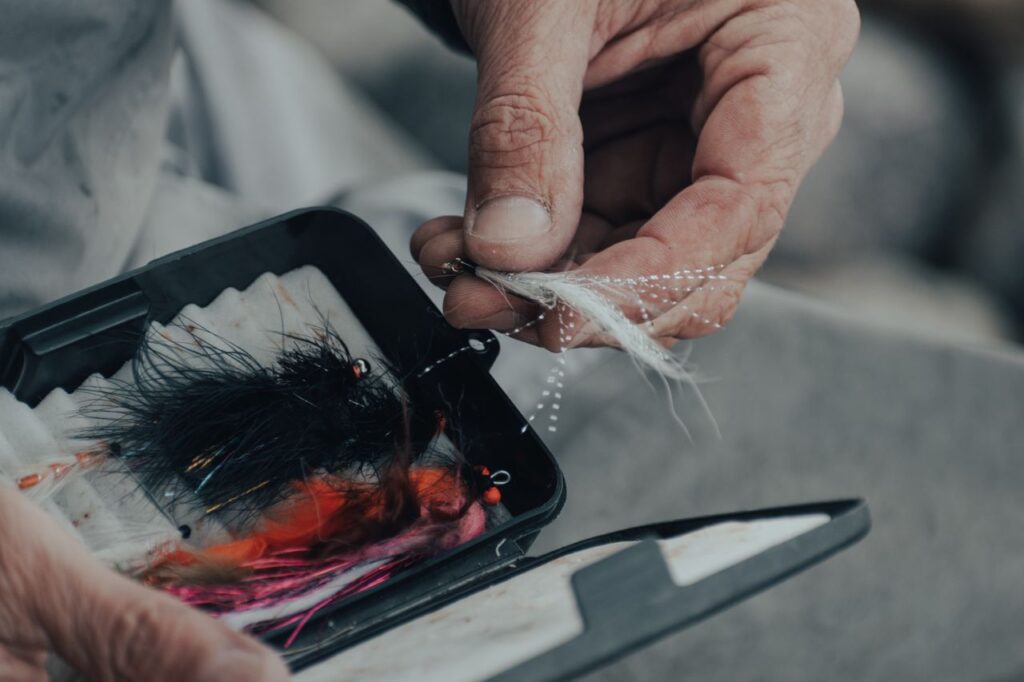
Flies and Fly Box
Flies are artificial patterns tied to imitate the food fish eat.
A fly box keeps those patterns organized and protected. Some boxes use foam slots for dry flies and nymphs, while others use larger compartments for streamers.
Organization matters because fly choice often changes quickly on the water. If fish switch from eating surface insects to subsurface nymphs, the angler needs to find the right pattern without wasting time or damaging flies.
A practical beginner box might include dry flies, nymphs, terrestrials, and streamers.
Common starter patterns include Adams, Elk Hair Caddis, Zebra Midge, Pat’s Rubber Legs, Woolly Bugger, and hopper patterns.
A simple fly box works because it covers different feeding zones. Dry flies cover the surface, nymphs cover subsurface feeding, terrestrials cover land insects, and streamers cover baitfish or larger prey.
Waders and Wading Boots
Waders help anglers enter the water while staying dry.
Chest waders are common for rivers, streams, and cold water. A wading belt should be worn for safety because it helps slow water entry if the angler slips.
Wading boots provide traction on rocks, gravel, mud, and slippery riverbeds.
Traction matters because a poor step can ruin a presentation or create a dangerous fall. It can also send pressure waves through shallow water and alert nearby fish.
Rubber soles are common and widely accepted. Felt soles can grip well on slick rocks, but some areas restrict them because of invasive species concerns.
Good wading is not only about reaching better water. It also helps the angler approach quietly, cast from better angles, and avoid standing where fish are likely feeding.
Basic Tools and Accessories
Nippers are used to cut tippet and tag ends after tying knots.
Clean cuts matter because messy tag ends can catch debris, weaken knots, or make small flies harder to rig.
Forceps or hemostats help remove hooks, pinch barbs, and handle small flies.
They also reduce handling time during catch and release. The faster the hook comes out, the less stress the fish experiences.
Floatant keeps dry flies riding on the surface. This matters because a dry fly that starts sinking may no longer match the insects fish are eating on top.
Strike indicators help detect subsurface takes when nymphing. Many subsurface eats are too subtle to feel, especially when slack, depth, or current speed separates the angler from the fly.
Split shot adds weight to help nymphs sink faster. This matters because a nymph that drifts above the feeding lane may never reach fish holding near the bottom.
A landing net helps control and release fish safely, especially when it has a rubber basket. Rubber is gentler on fins and the fish’s protective slime layer.
Polarized sunglasses reduce glare and help anglers see fish, structure, depth changes, and obstacles in the water.
They also improve safety by protecting the eyes from hooks and helping the angler read the water before stepping.
A vest, sling pack, hip pack, or chest pack keeps tools and flies within reach while fishing.
Good storage matters because fly fishing often requires small adjustments. Changing tippet, adding split shot, applying floatant, or switching flies is easier when the right tool is available immediately.
| Gear Item | Main Purpose | Why It Matters |
| Fly rod | Casts the fly line and controls the fish | Matches line weight, fly size, wind, and target species |
| Fly reel | Stores fly line and backing | Helps manage line and control stronger fish |
| Fly line | Carries the cast | Affects casting, presentation, mending, and depth |
| Leader | Connects fly line to tippet | Transfers energy and helps the fly land naturally |
| Tippet | Fine terminal line near the fly | Affects stealth, fly movement, and knot strength |
| Backing | Extra line capacity | Protects against long runs from strong fish |
| Fly box | Stores and organizes flies | Helps the angler change patterns quickly |
| Strike indicator | Shows subtle subsurface takes | Helps detect nymph eats that may not be felt |
| Split shot | Adds sink rate | Helps nymphs reach the feeding zone |
| Floatant | Helps dry flies float | Keeps surface flies riding correctly |
| Landing net | Helps land and release fish safely | Reduces handling stress and protects fish |
| Forceps | Removes hooks and pinches barbs | Speeds up release and improves fish handling |
| Nippers | Cuts tippet and tag ends | Makes rigging cleaner and faster |
| Waders | Keeps the angler dry | Improves water access in rivers and cold conditions |
| Wading boots | Provides traction | Improves safety and quieter movement |
| Polarized sunglasses | Reduces glare | Helps spot fish, structure, depth, and hazards |
Main Fly Fishing Techniques
Fly fishing changes based on where the fish are feeding and what the angler wants the fly to imitate.
Some techniques keep the fly on the surface. Others put the fly below the surface, near the bottom, or moving through the water like baitfish.
The five core methods most anglers learn are dry fly fishing, wet fly fishing, nymphing, Euro nymphing, and streamer fishing.
Dry Fly Fishing
Dry fly fishing presents a floating fly on the surface of the water.
This technique is most exciting when fish are rising and eating insects from the surface film.
A dry fly might imitate a mayfly, caddisfly, stonefly, midge, ant, beetle, or grasshopper.
The main goal is a natural drift. The fly should float at the same speed as the current without dragging across the surface.
Floatant helps keep dry flies riding high. A floating fly line, tapered leader, and fine tippet help create a cleaner surface presentation.
Dry fly fishing is visual, which makes it easier for beginners to understand. The angler can see the fly, watch the drift, and often see the fish eat.
Wet Fly Fishing
Wet fly fishing presents a fly below the surface.
Unlike dry flies, wet flies are meant to sink or ride just under the surface film.
Wet flies often imitate drowned insects, emerging insects, small aquatic life, or insects being swept through the current.
A common method is to cast across or slightly downstream, then let the fly swing through the current.
This swing gives the fly movement without needing a fast retrieve. It can be effective when fish are feeding below the surface but not directly on the bottom.
Wet fly fishing is simple and useful because it covers water well. It also teaches anglers how current affects fly movement.
Nymphing
Nymphing imitates immature aquatic insects that live below the surface.
Many fish, especially trout, feed below the surface more often than they feed on top. That makes nymphing one of the most productive fly fishing techniques.
A nymph rig often uses a nymph fly, strike indicator, split shot, leader, and tippet.
The indicator helps show when a fish takes the fly. Split shot helps the fly sink to the right depth.
Good nymphing depends on depth and drift. The fly should move naturally near the feeding lane without dragging unnaturally.
Common nymph patterns include Zebra Midges, Pheasant Tails, Hare’s Ears, Copper Johns, and Pat’s Rubber Legs.
Euro Nymphing
Euro nymphing is a tight-line nymphing technique.
Instead of relying on a floating indicator, the angler keeps direct contact with weighted nymphs through a long leader and visible sighter.
This method reduces slack and helps the angler feel or see subtle strikes.
Euro nymphing often uses tungsten nymphs because they sink quickly without needing much split shot.
The technique is especially useful in pocket water, riffles, runs, and places where fish hold close to the bottom.
It requires more line control than basic indicator nymphing, but it gives excellent sensitivity and depth control.
Streamer Fishing
Streamer fishing uses larger flies to imitate baitfish, leeches, crayfish, sculpins, or other swimming prey.
Instead of drifting naturally like a dry fly or nymph, a streamer is usually retrieved, stripped, swung, or pulsed through the water.
Streamer fishing can trigger aggressive strikes from trout, bass, pike, salmon, and saltwater fish.
A sinking line or sink-tip line is often useful when streamers need to reach deeper water.
Common streamer patterns include Woolly Buggers, Clouser Minnows, Zonkers, Muddler Minnows, and baitfish patterns.
Streamer fishing is active and direct. The angler controls the movement of the fly and often searches for fish that are willing to chase.
| Technique | Where the Fly Rides | Common Gear | Best Use |
| Dry fly fishing | Surface | Dry fly, floating line, floatant | Rising fish and surface insects |
| Wet fly fishing | Just below the surface | Wet fly, leader, swing rig | Subsurface insects and soft current swings |
| Nymphing | Below the surface | Nymph, strike indicator, split shot | Fish feeding near the bottom |
| Euro nymphing | Below the surface | Long leader, tungsten nymph, sighter | Tight-line control and precise depth |
| Streamer fishing | Mid-depth to deep water | Streamer, sinking line, strip retrieve | Predatory fish and aggressive takes |
Fly Casting and Line Control
Casting is one of the first skills people notice in fly fishing, but line control matters just as much as the cast itself.
A good cast puts the fly in the right place. Good line control keeps the fly moving naturally after it lands.
Beginners do not need to master every cast at once. A basic overhead cast, roll cast, and simple mend are enough to start fishing many rivers, ponds, and streams.
Roll Cast
The roll cast is useful when there is not enough room for a full backcast.
Instead of sending the line behind the angler, the roll cast uses tension from the line on the water to load the rod.
This cast works well on small streams, brushy banks, tight river corners, and places with trees or tall grass behind the angler.
It is also useful for resetting a nymph rig, lifting line from the water, or making short controlled casts.
The roll cast is one of the most practical casts for beginners because it solves a common problem right away.
False Cast
A false cast keeps the fly line moving through the air without letting the fly land on the water.
Anglers use false casts to adjust distance, change direction, control line, or dry a floating fly.
False casting is useful, but too much of it can create problems.
Extra false casts can spook fish, waste time, and increase the chance of tangles. In many situations, one or two false casts are enough.
The goal is not to look busy. The goal is to place the fly accurately with as little wasted motion as possible.
Double Haul
The double haul increases line speed by using both the rod hand and the line hand.
As the rod moves through the casting stroke, the line hand pulls on the fly line to add power and speed.
This cast is useful when the angler needs more distance, tighter loops, or better control in wind.
It is common in saltwater fly fishing, streamer fishing, and large open rivers where longer casts matter.
Beginners do not need the double haul on the first day. It becomes more useful once basic casting mechanics are consistent.
Reach Cast
The reach cast helps create a better drift.
After the forward cast, the angler reaches the rod to one side before the line lands. This places the fly line upstream or downstream of the fly.
The goal is to delay drag and let the fly drift more naturally through mixed currents.
Reach casts are especially useful in dry fly fishing because surface flies are easy for fish to inspect.
A reach cast can also help when fishing current seams, soft edges, and slower water beside faster current.
Spey Casting
Spey casting uses a longer rod, often a two-handed rod, to make casts with limited backcast space.
It is common for steelhead, salmon, and large-river fishing.
Instead of relying on a long backcast, Spey casting uses water tension, a shooting head, running line, and a controlled sweep to send the fly across the river.
Spey casting is useful when fishing broad rivers, heavy sink tips, or swung flies.
It is not usually the first casting style a beginner needs to learn, but it is an important part of fly fishing for migratory fish.
Mending After the Cast
Mending means moving the fly line on the water after the cast.
A mend helps control how the current pulls the line, leader, and fly.
If fast current grabs the fly line, the fly may drag unnaturally. A well-timed mend can slow that pull and extend the drift.
Mending is often more important than casting distance. A short cast with a clean mend usually fishes better than a long cast with poor line control.
The rod tip, current speed, leader length, and casting angle all affect how the mend works.
Drift Control
Drift control is the ability to keep the fly moving like natural food.
For dry flies, that usually means a drag-free surface drift. For nymphs, it means getting the fly down and letting it move naturally near the feeding lane.
For streamers, drift control changes into retrieve control. The angler may strip, pause, swing, or pulse the fly to imitate prey.
The best presentation depends on the technique, current, depth, and target species.
| Cast or Line Skill | Main Use | Best Situation |
| Roll cast | Casting with limited backcast space | Small streams, brushy banks, tight water |
| False cast | Adjusting line, distance, and direction | Drying flies and setting up the final cast |
| Double haul | Adding line speed and distance | Wind, saltwater, long casts |
| Reach cast | Improving drift | Dry flies, current seams, technical water |
| Spey cast | Casting with two-handed rods | Steelhead, salmon, large rivers |
| Mending | Repositioning line on the water | Reducing drag and extending drift |
| Drift control | Managing fly movement | Dry flies, nymphs, wet flies, streamers |
Best Fish Species for Fly Fishing
Fly fishing can be used for many freshwater and saltwater fish.
Trout are the classic target, but fly anglers also catch steelhead, salmon, bass, pike, bonefish, permit, tarpon, panfish, carp, and other species.
The right setup depends on fish size, water type, fly size, wind, casting distance, and how hard the fish fights.
Trout
Trout are one of the most popular fly fishing species because they feed heavily on aquatic insects.
Dry flies, nymphs, wet flies, and small streamers can all catch trout depending on the water and season.
Trout often hold near current seams, riffles, pools, undercut banks, boulders, and shaded edges.
A good trout presentation usually depends on drift. The fly should move naturally through the feeding lane without dragging or sinking at the wrong depth.
Steelhead
Steelhead are migratory rainbow trout that move between larger bodies of water and rivers.
They are often targeted with swung flies, two-handed rods, Spey casts, and larger fly patterns.
Steelhead fishing is usually less about catching numbers and more about covering water carefully.
A typical steelhead presentation may involve casting across the current, mending the line, and letting the fly swing through likely holding water.
Salmon
Salmon can be targeted with fly fishing in rivers, estuaries, and coastal systems where regulations allow it.
Fly anglers often use strong rods, durable reels, sinking tips, Spey rods, and salmon flies.
Salmon fishing can involve swinging flies, drifting patterns, or presenting flies near travel lanes and holding areas.
Because salmon are powerful fish, gear strength and fish handling matter. A weak setup can lead to long fights, broken tippet, or exhausted fish.
Bass
Bass are excellent warmwater fly fishing targets.
Largemouth and smallmouth bass will eat poppers, streamers, crayfish patterns, baitfish patterns, and large terrestrials.
Surface poppers can create aggressive strikes in shallow water, especially around weeds, docks, banks, and structure.
Streamers are useful when bass are deeper, chasing baitfish, or holding near cover.
Pike
Pike are aggressive predators that respond well to large streamers.
They often hold around weeds, drop-offs, shallow bays, and ambush cover.
Fly fishing for pike usually requires heavier rods, strong leaders, and wire or bite tippet because pike have sharp teeth.
Large flies can be tiring to cast, so rod weight, line choice, and casting mechanics become more important.
Bonefish
Bonefish are a major saltwater fly fishing target on tropical flats.
They are usually caught by sight fishing in shallow water with shrimp or small baitfish patterns.
Bonefish are fast, cautious, and often found in clear water. Accurate casting and quiet movement matter as much as fly choice.
An 8-weight rod is a common bonefish setup because it balances casting distance, wind control, and fish-fighting power.
Permit
Permit are one of the most challenging flats species for fly anglers.
They often feed on crabs, shrimp, and small crustaceans, but they can be extremely selective.
Permit fishing usually requires accurate casting, strong patience, and careful fly presentation.
A 10-weight rod is common because permit are strong fish and saltwater flats often involve wind.
Tarpon
Tarpon are large, powerful saltwater fish known for long runs and jumps.
Fly anglers target them with tarpon flies, shock tippet, strong reels, and heavy rods.
A 12-weight rod is common for larger tarpon because the fish can be difficult to control.
Tarpon fishing requires strong knots, accurate casting, and careful pressure during the fight.
| Species | Common Setting | Common Flies | Typical Setup Direction |
| Trout | Coldwater streams and rivers | Dry flies, nymphs, small streamers | Light to medium fly rods |
| Steelhead | Large rivers | Spey flies and swung patterns | Two-handed rods and swing lines |
| Salmon | Anadromous rivers | Salmon flies and sinking-tip setups | Strong rods, reels, and leaders |
| Bass | Lakes, ponds, and warmwater rivers | Poppers, streamers, crayfish patterns | Medium rods and floating or sinking lines |
| Pike | Weedy lakes and slow rivers | Large streamers | Heavy rods and wire leaders |
| Bonefish | Saltwater flats | Shrimp flies and small baitfish patterns | 8-weight rod and saltwater reel |
| Permit | Tropical flats | Crab flies and shrimp patterns | 10-weight rod and fluorocarbon leader |
| Tarpon | Flats, channels, and coastal water | Tarpon flies | 12-weight rod and shock tippet |
Catch and Release in Fly Fishing
Catch and release is common in fly fishing because many anglers want to protect fish populations and keep productive water healthy.
Good release habits matter because a fish can swim away and still be harmed if it was fought too long, handled roughly, kept out of the water too long, or released in poor condition.
The goal is simple. Land the fish quickly, handle it carefully, remove the hook cleanly, and let it recover before it swims away.
Why Fish Handling Matters
Fish have a protective slime layer that helps guard them from infection.
Dry hands, rough surfaces, dirt, and abrasive nets can damage that layer.
Fish also become stressed during a fight. The longer the fight lasts, the more important careful handling becomes.
Warm water can make this worse because fish recover more slowly when oxygen levels are lower.
Use the Right Landing Net
A landing net helps control the fish without dragging it onto rocks, grass, sand, or a muddy bank.
A rubber net is better for catch and release because it is gentler on fins, scales, and the slime layer.
The net also keeps the fish in the water while the angler gets ready to remove the hook.
This is especially helpful when using small flies, fine tippet, or barbless hooks.
Keep the Fish Wet
A fish should stay in the water as much as possible.
Wet hands before touching the fish. This reduces friction and helps protect the fish’s outer coating.
If a photo is taken, keep it quick. Lift the fish only when the camera is ready, then return it to the water right away.
A simple rule is to treat air exposure like holding your own breath. The shorter it is, the better.
Remove the Hook Quickly
Barbless hooks make release easier.
They come out with less pressure and usually cause less damage than barbed hooks.
Forceps or hemostats help remove hooks from small mouths, deep angles, or awkward positions.
If the hook is difficult to remove without harming the fish, it may be better to cut the tippet close rather than keep digging.
Where Fly Fishing Is Used
Fly fishing works in many types of water.
Some settings require short casts and stealth. Others require long casts, sinking lines, boats, or strong wind control.
Understanding the water helps anglers choose the right rod, line, leader, fly, and presentation.
The same fly can behave very differently in different water. A dry fly that drifts well in a small stream may drag badly across a spring creek seam, while a streamer that works in a pond may need a different line to reach fish in deeper lake water.
Small Stream Fishing
Small stream fishing often happens in tight quarters.
The water may be narrow, shaded, brushy, and full of obstacles behind the angler.
Short rods, roll casts, bow-and-arrow casts, and careful wading can help in these conditions.
Small stream fish are often willing to eat dry flies, terrestrials, and dry-dropper rigs when approached quietly.
Stealth matters more than distance because fish in small water have less room to escape pressure. A heavy step, sudden shadow, or fly line landing over the pool can alert fish before the fly reaches them.
Short accurate casts are usually better than long casts that land hard or create too much line on the water.
Less line also means better control. When only a short section of fly line and leader touches the water, there is less current pulling against the fly and less chance of immediate drag.
Spring Creek Fishing
Spring creeks are clear, steady, and often technical.
Because the water is clear and fish have more time to inspect the fly, presentation must be careful.
Long leaders, fine tippet, small flies, and accurate drift are often important.
Spring creek trout may refuse flies that look slightly wrong or drag unnaturally.
This happens because the water is often smooth enough for fish to study food before eating. A fly that moves faster than the bubbles, cuts across the current, or rides at the wrong depth can look suspicious.
Microcurrents also matter in spring creeks. The fly may drift in one thin lane while the leader or fly line crosses a nearby lane moving at a different speed.
That difference can pull the fly just enough to create drag. Experienced anglers often spend more time choosing the casting angle than changing flies because the correct angle helps the fly drift naturally for longer.
A slow approach helps. Anglers should watch for rises, feeding lanes, current seams, and small changes in water movement before casting.
Stillwater Fly Fishing
Stillwater fly fishing happens in lakes, ponds, reservoirs, and calm backwaters.
The challenge is different from river fishing because there is little or no current to carry the fly.
Depth, retrieve speed, wind direction, temperature, weed beds, drop-offs, and fish movement become more important.
In moving water, the current helps bring food to fish. In stillwater, fish often cruise, suspend, or move along structure to find food.
That means the angler has to think more about where fish are in the water column. A fly that is two feet above feeding fish may be ignored, even if the pattern is right.
Common stillwater flies include chironomids, leeches, damsel nymphs, streamers, poppers, and baitfish patterns.
A floating line can work near the surface. Sinking lines and intermediate lines help reach fish holding deeper.
Retrieve speed also matters because the angler creates most of the fly’s movement. A slow hand-twist retrieve can imitate small aquatic insects, while short strips can make a streamer look like a fleeing baitfish.
Wind can help or hurt. A light chop can hide the leader and push food toward one bank, but strong wind can make casting harder and drag floating lines away from the target depth.
Flats Fishing
Flats fishing is shallow-water sight fishing, usually in saltwater.
Anglers look for fish before casting, then place the fly ahead of the fish without spooking it.
Bonefish, permit, tarpon, redfish, and other flats species require accuracy, timing, and calm movement.
Presentation is different on the flats because the fish is often moving. The fly must land far enough ahead to be noticed, but not so close that it scares the fish.
A cast that is perfect for a river trout may be too soft, too late, or too short on the flats. The angler often has only a few seconds to read the fish’s direction, account for wind, and place the fly in the path of travel.
Polarized sunglasses are essential because they reduce glare and help anglers see fish, bottom changes, grass, sand, and current.
They also help the angler avoid blind casting to empty water. Flats fishing rewards seeing first and casting second.
Wind is a major factor on the flats. This is why stronger rods, heavier lines, and double hauling are often part of saltwater fly fishing.
The extra power helps turn over larger flies and longer leaders in moving air. Without enough line speed, the cast can fall short, land in a pile, or miss the narrow window where the fish can see the fly.
| Setting | Main Challenge | Why It Matters | Useful Gear or Technique |
| Small streams | Tight casting space and spooky fish | Fish are close, cover is limited, and poor wading can alert the whole pool | Short rod, roll cast, dry-dropper rig |
| Spring creeks | Clear water and selective trout | Fish can inspect the fly, tippet, drift, and drag more closely | Long leader, small flies, careful approach |
| Stillwater | Finding fish depth and movement | Fish cruise, suspend, and relate to structure without current feeding lanes | Sinking line, float tube, chironomid, streamer |
| Flats | Wind, distance, and sight fishing | The fly must reach moving fish quickly without landing too close | Polarized sunglasses, accurate cast, saltwater rod |
Common Fly Fishing Mistakes Beginners Should Avoid
Most beginner fly fishing problems come from trying to do too much at once.
New anglers often focus on long casts, perfect fly selection, or expensive gear before learning simple presentation skills.
The best early progress usually comes from cleaner casts, better line control, shorter drifts, and calmer movement around fish.
Fly fishing rewards control more than coverage. A beginner who fishes one short run carefully will often learn more than an angler who casts across every piece of water without understanding how the fly is moving.
Using Too Many False Casts
False casting is useful, but it is easy to overdo.
Too many false casts can spook fish, create wind knots, disrupt timing, and keep the fly away from the water.
Fish can react to motion above the water, especially in clear streams, shallow flats, and calm pools. A fly line flashing back and forth can warn fish before the fly ever lands.
Extra false casts also increase the chance of tailing loops and knots because the timing has more chances to break down.
The fly only has a chance to catch fish when it is fishing.
In most situations, one or two false casts are enough to adjust distance or direction before presenting the fly.
Ignoring the Drift
A poor drift can ruin a good fly choice.
If the fly moves faster, slower, or sideways compared with the current around it, fish may refuse it.
This happens because fish are used to seeing natural food move with the water. A mayfly, midge, or nymph does not usually cut across the current at a different speed unless something is pulling it.
That pull often comes from the fly line or leader landing across mixed currents. One part of the line may sit in fast water while the fly sits in slower water, creating tension that drags the fly out of the feeding lane.
Trout are especially sensitive to this because they often hold in one place and watch many food items pass by. When one item moves differently from the rest, it looks unsafe.
Mending, reach casts, better angles, and shorter casts can all help improve the drift.
The goal is not always to cast farther. The goal is to give the fly the longest natural drift through the most likely feeding lane.
Fishing Too Far Away
Many beginners think longer casts are always better.
In real fishing, shorter accurate casts often catch more fish because the angler has better control over the fly line and leader.
Long casts create more line on the water, and more line means more current can pull against the presentation.
They also create more slack between the angler and the fly. That slack can delay hook sets, hide subtle strikes, and make mending harder.
Shorter casts keep the system simpler. The angler can see the fly better, control the drift better, and react faster when a fish eats.
A beginner should first learn to fish well within comfortable casting range before trying to reach distant water.
Experienced anglers often fish less water but fish it better. They choose the right lane, cast from the best angle, and manage the line so the fly stays believable for longer.
Choosing the Wrong Fly Line
Fly line choice affects how the fly casts, lands, floats, sinks, and moves.
A weight-forward floating line is the best all-around choice for many beginners.
It works for dry flies, many nymph rigs, light streamers, and general freshwater fishing.
Floating line also makes learning easier because it is visible and easier to mend. Beginners can see how the current pulls the line and how that pull changes the fly’s movement.
Sinking lines, sink-tip lines, and specialty lines are useful later when fishing deeper water, streamers, stillwater, or saltwater.
The wrong line can put the fly in the wrong part of the water column. A floating line may keep a streamer too high, while a sinking line may pull a dry fly or shallow nymph rig out of position.
Line choice should match the depth, fly type, retrieve, and target species rather than the idea that one line can solve every situation.
Using the Wrong Tippet Size
A tippet that is too heavy can make small flies look unnatural.
Tippets that are too light can break when casting large flies or fighting stronger fish.
The right tippet depends on fly size, fish size, water clarity, cover, and presentation.
Heavy tippet creates more resistance in the water. On small dry flies and nymphs, that resistance can make the fly look stiff or prevent it from drifting freely.
Light tippet gives a fly more natural movement, but it also reduces strength. That becomes a problem around rocks, weeds, strong current, large fish, or heavy streamers.
For beginners, the key is to avoid extremes. Match lighter tippet with smaller flies and heavier tippet with larger flies or stronger fish.
A good tippet choice balances stealth, movement, and control.
Moving Too Fast Around Fish
Fish can feel vibration, see movement, and react to shadows.
Walking too quickly, splashing while wading, or casting over fish can ruin good water before the first proper presentation.
This matters because fish often detect the angler before the angler detects the fish. A careless step can send pressure waves through shallow water, and a shadow across a pool can make fish stop feeding.
A careful approach often matters more than a perfect fly.
Slow down, watch the water, and cast only after choosing a target lane.
Many good presentations begin before the cast. The angler chooses where to stand, how low to stay, which current lane to fish, and how to avoid lining the fish.
Poor Fish Handling
Landing the fish is not the end of the process.
A fish can be harmed by dry hands, rough banks, long photo sessions, or deep hook removal attempts.
Fish have a protective outer coating that helps defend them from infection. Dry hands, dirt, grass, and abrasive nets can damage that layer.
Long fights can also exhaust fish, especially in warm water or heavy current. A fish that swims away weakly may still be in poor condition after release.
Use a rubber net, keep the fish wet, remove the hook quickly, and release it only when it can swim away strongly.
This keeps catch and release aligned with the reason many anglers practice it in the first place.
Fly Fishing Setup for Beginners
A beginner fly fishing setup should be simple, balanced, and easy to use.
The goal is not to own every specialized tool. The goal is to build a setup that can handle common water, common fish, and common techniques without making learning harder.
For most new freshwater anglers, a basic rod, reel, floating line, leader, tippet, flies, and a few tools are enough to begin.
A simple setup helps because beginners need fewer variables to manage. When the rod, line, leader, and flies are balanced, it becomes easier to understand what is causing a problem, whether it is casting, drift, depth, or fly choice.
Simple Beginner Freshwater Setup
A general freshwater setup usually starts with a medium-weight fly rod.
A 5-weight fly rod is one of the most common beginner choices because it can handle trout, panfish, small bass, dry flies, nymphs, and light streamers.
This rod weight works well because it is light enough for delicate presentations but strong enough to turn over common beginner rigs. It gives new anglers room to learn without forcing them into highly specialized gear too early.
The rod should be matched with a fly reel, backing, and a weight-forward floating line.
A matching line matters because the line is what loads the rod during the cast. If the line is too light or too heavy for the rod, the beginner may struggle with timing and assume the problem is skill when the setup is partly to blame.
A tapered leader and a few spools of tippet give the angler enough flexibility to change flies and adjust presentations.
This flexibility matters because conditions change on the water. A dry fly may need lighter tippet for a softer drift, while a streamer or larger nymph may need stronger tippet for better turnover and control.
Beginner Tools and Accessories
Nippers, forceps, floatant, strike indicators, split shot, and a fly box cover most basic needs.
These tools help beginners make small adjustments without rebuilding the entire setup. That matters because fly fishing often improves through small changes, such as trimming a knot, adding weight, changing depth, or drying a floating fly.
Polarized sunglasses are also important because they reduce glare and protect the eyes from hooks.
They also help beginners read the water. Seeing depth changes, rocks, weed lines, current seams, and fish movement makes it easier to understand where a cast should go.
A landing net is useful for safer fish handling, especially when practicing catch and release.
A net reduces the need to drag fish onto the bank or hold them too tightly. It also gives the angler more control while removing the hook.
Waders and wading boots are helpful for rivers and cold water, but they are not always necessary for ponds, banks, docks, or warm shallow streams.
Beginners should buy them based on access. If good fishing is available from the bank, a dock, or shallow shoreline, waders can wait until they are actually needed.
Simple Beginner Fly Selection
A beginner does not need dozens of fly patterns.
It is better to start with a small group of proven flies that cover surface, subsurface, and active retrieve situations.
This works because fish feed in different zones. Some feed on the surface, some feed below the surface, and some chase larger prey.
Adams, Elk Hair Caddis, and small hopper patterns can cover many dry fly situations.
These flies help beginners learn surface presentation because the fly is visible. The angler can watch the drift, see drag, and understand how current affects the fly.
Zebra Midges, Hare’s Ears, Pheasant Tails, and Pat’s Rubber Legs can cover many nymphing situations.
These patterns are useful because many fish feed below the surface more often than they rise. A beginner who only fishes dry flies may miss fish that are actively feeding deeper.
Woolly Buggers and small streamers can help when fish are chasing baitfish, leeches, or larger prey.
Streamers teach a different type of control. Instead of relying on a natural drift, the angler controls movement through strips, pauses, swings, and retrieves.
What to Buy First
Start with the items that directly help you fish.
A rod, reel, backing, fly line, leader, tippet, flies, nippers, forceps, and fly box should come before specialty gear.
These items form the working system. Without them, the angler cannot cast properly, change flies efficiently, manage fish safely, or adjust to surface and subsurface feeding.
Add waders, boots, packs, extra lines, and tying tools once you know where you fish most often.
This keeps the first setup practical and prevents buying gear that does not match your local water.
A beginner who mostly fishes ponds may need different extras than someone who wades cold trout streams. The best gear choice comes after the angler understands their water, not before.
| Category | Beginner Option | Why It Works |
| Rod | General freshwater fly rod | Handles common fish, flies, and beginner casting situations |
| Reel | Matching fly reel with backing | Stores line, balances the rod, and provides reserve capacity |
| Line | Weight-forward floating line | Loads the rod easily and works for many basic presentations |
| Leader | Tapered leader | Transfers casting energy and helps the fly land naturally |
| Tippet | Nylon or fluorocarbon tippet | Adjusts fly movement, stealth, and strength |
| Flies | Dry flies, nymphs, and streamers | Covers surface feeding, subsurface feeding, and active retrieves |
| Tools | Nippers and forceps | Makes rigging cleaner and fish handling faster |
| Accessories | Floatant, indicators, split shot | Helps control floating flies, strike detection, and depth |
| Visibility | Polarized sunglasses | Reduces glare, protects eyes, and helps read water |
| Fish handling | Rubber landing net | Helps control and release fish with less stress |
Fly Fishing FAQs
Is fly fishing hard to learn?
Fly fishing has a learning curve because casting, line control, and presentation feel different from conventional fishing.
Most beginners struggle more with timing and line control than with the gear itself.
The easiest way to learn is to start with short casts, simple rigs, and one or two basic techniques before adding more advanced methods.
What gear do I need to start fly fishing?
A beginner fly fishing setup needs a fly rod, fly reel, backing, fly line, leader, tippet, flies, nippers, forceps, and a fly box.
Polarized sunglasses are also strongly recommended because they reduce glare and protect your eyes from hooks.
Waders, wading boots, landing nets, floatant, strike indicators, split shot, and packs are useful, but they depend on where you fish and how often you go.
What is the best fly fishing technique for beginners?
Dry fly fishing is easy to understand because you can see the fly and watch the fish eat on the surface.
Indicator nymphing is often more productive because many fish feed below the surface most of the time.
A good beginner approach is to learn both. Dry flies teach visual presentation, while nymphing teaches depth, drift, and strike detection.
What is the difference between fly line, leader, and tippet?
Fly line is the weighted line that carries the cast.
The leader connects the fly line to the fly and tapers down so the cast can turn over smoothly.
The tippet is the fine section tied closest to the fly. It helps the fly move naturally and makes it easier to change flies without shortening the leader too much.
How do I know which fly to use?
Start by watching the water.
If fish are rising, choose a dry fly or emerger that roughly matches the size and shape of the insects on the surface.
If fish are not rising, use a nymph, wet fly, or streamer to cover subsurface feeding.
Fly choice matters, but size, depth, drift, and presentation usually matter more than perfect color or tiny details.
Can you fly fish in lakes and ponds?
Yes, fly fishing works well in lakes, ponds, reservoirs, and other stillwater settings.
Stillwater fly fishing often uses nymphs, chironomids, leeches, baitfish patterns, poppers, and streamers.
Because there is little current, anglers need to pay more attention to depth, retrieve speed, wind direction, weed beds, drop-offs, and fish movement.
What fish can you catch with fly fishing?
Fly fishing can catch trout, bass, steelhead, salmon, pike, panfish, carp, bonefish, permit, tarpon, and many other freshwater and saltwater fish.
The setup changes based on the species.
Small trout may require light rods, fine tippet, and small flies, while tarpon, pike, salmon, and saltwater species require stronger rods, heavier leaders, larger flies, and more durable reels.
Start Fly Fishing With the Right Setup and Better Presentation
Fly fishing becomes easier when you understand how the rod, reel, line, leader, tippet, flies, and presentation work together.
The best starting point is simple gear, a few proven fly patterns, short accurate casts, and a strong focus on natural drift.
Once the basics feel comfortable, you can branch into dry fly fishing, nymphing, Euro nymphing, streamer fishing, Spey casting, stillwater fly fishing, flats fishing, fly tying, and more species-specific approaches.
The goal is not to master everything at once.
Start with one setup, one type of water, and one or two techniques. Then build skill through time on the water, better observation, cleaner presentations, and safer fish handling.